












How AI Changes Exposure Management: From Static Findings to Continuous Risk Decisions
Introduction: The Snapshot Problem
Every security team knows the feeling. The quarterly vulnerability scan completes. The report lands, with thousands of findings, color-coded by CVSS severity, neatly timestamped. And the moment it’s printed, it’s already out of date.
That is the fundamental flaw at the heart of traditional exposure management: it is built around a point in time. Static scans, periodic assessments, and batch-processed findings weren’t designed to keep pace with the velocity of modern enterprise environments. There’s a gap that exists between “we found something” and “we fixed something.” This gap is precisely where breaches happen.
AI is changing the cybersecurity calculus by compressing cycle times, enriching context, and transforming isolated findings into a living picture of risk that security teams can act on continuously. This shift is happening now, as we speak, and organizations that make the transition from static vulnerability management to continuous, AI-driven risk decisions are building a measurably stronger security posture.
Why Static Findings Fall Short in Large Organizations
Traditional vulnerability management tools were built for a world where the attack surface was bounded and concrete. It involved a defined set of servers, applications, and endpoints that could be inventoried and scanned on a schedule.
Today’s enterprises routinely surface tens of thousands of vulnerabilities across their environment in a single scan cycle. This creates a significant scale problem where, without intelligent filtering, every finding competes equally for attention. This in turn creates the alert fatigue security teams universally report as one of their biggest operational challenges. Nearly nine in ten security professionals say alert fatigue is actively preventing them from remediating critical vulnerabilities. The result is a remediation backlog that grows faster than teams can work it down.
The context problem is equally damaging. A CVE with a 9.8 CVSS score sounds alarming, and sometimes it deserves the score. But if the affected system is air-gapped, not internet-facing, and has compensating controls already in place, that “critical” finding may represent far less actual risk than a medium-severity misconfiguration on, for example, a customer-facing API gateway.
Static scoring doesn’t tell the true story. It can’t, because it lacks access to business context, asset criticality, network topology, and real-time threat intelligence required to do so.
The timing problem is structural. Point-in-time scanning captures a frozen frame in a moving risk picture. Cloud infrastructure, container environments, and modern CI/CD pipelines introduce new assets and configurations continuously and often between scan windows. Vulnerabilities introduced on Monday may not surface in the next scan until the following week or month. By then, exploitation windows have opened and closed.
These aren’t edge cases or implementation failures. They are design limitations of an approach built for an era that no longer exists.
What Continuous Exposure Management Actually Means
The cybersecurity industry has coalesced around a framework that addresses these limitations directly. Continuous Threat Exposure Management (CTEM) is a structured, five-stage program (Scoping, Discovery, Prioritization, Validation, and Mobilization) that reframes exposure management as an ongoing cycle rather than a periodic event.
CTEM is a strong pivot for CISOs looking to move beyond traditional technology vulnerability management to a broader, more dynamic approach to risk. The CTEM philosophy aligns tightly with how AI-augmented platforms approach exposure management:
- Continuous discovery replaces scheduled scans with always-on asset inventory that updates as environments change.
- Risk-based prioritization replaces CVSS-only rankings with context-aware scoring that incorporates asset criticality, exploitability evidence, and business impact.
- Validation moves from static assumption (“this is patched”) to active verification.
- Mobilization connects findings directly to remediation workflows, closing the loop between identification and action.
None of these stages can operate at enterprise scale without automation. Increasingly, that automation comes in the form of AI.
How AI Transforms Each Stage of the Risk Decision Cycle
From Discovery to Continuous Visibility
AI-powered platforms don’t wait for the next scan window. They ingest data continuously across the board, from scanners, cloud APIs, agent telemetry, SaaS configurations, third-party integrations, and more, normalizing findings from disparate sources into a unified asset and exposure inventory. This aggregation layer is foundational: you can’t manage what you can’t see, and you can’t see clearly when your data lives in siloed tools using different formats.
From Severity Scores to Risk Decisions
This is where AI makes its most significant contribution. Instead of presenting a raw list of findings sorted by CVSS score, AI-driven platforms apply layered intelligence to answer a fundamentally different question: What should we fix first, given everything we know about our environment, our business, and the current threat landscape?
That intelligence layer typically incorporates:
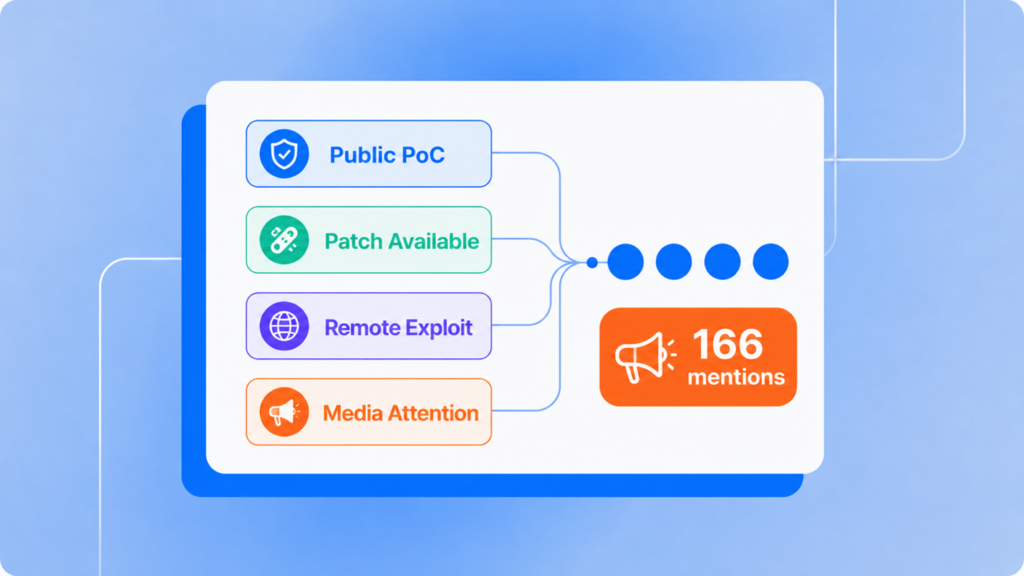
- Threat intelligence feeds. Is this vulnerability actively exploited in the wild? Are there known proof-of-concept exploits publicly available?
- Asset context. What is the business criticality of the affected system? Is it internet-facing? Does it process regulated data?
- Environmental factors. Are compensating controls in place? Is the vulnerable component reachable from a trust boundary?
- Remediation feasibility. How complex is the fix? Who owns the asset? What is the expected SLA for this team?
AI models trained on these variables can produce dynamic risk scores that update in real time as conditions change. A vulnerability that was low priority yesterday may become urgent today if a new exploit kit is published, or if the asset moves into a critical business process. This is the difference between a static finding and a living risk decision.
From Backlog Management to Remediation Orchestration
Even perfect prioritization fails if the handoff to remediation is broken. In many organizations, this is the longest and most painful gap: security identifies the problem, but IT operations fixes it. The handoff between them is manual and lossy, slowing everything down.
AI-powered remediation orchestration changes this by automating the routing of findings to the right owners, pre-populating tickets with context-rich remediation guidance, and tracking status without requiring manual follow-up. Workflows are configured to account for SLA policies, team structures, and escalation paths, transforming what was once a spreadsheet-driven process into a structured, auditable pipeline.
The Shift in Mental Model: From Findings to Decisions
Perhaps the most important change AI brings to exposure management isn’t technical. It’s a cognitive difference:
Static vulnerability management implicitly asks: What did we find?
Continuous, AI-driven exposure management asks: What should we do next, and why?
This shift matters for several reasons.
First, it aligns security to business outcomes. When risk decisions are framed in terms of business impact — this exposure affects our payment processing environment; this misconfiguration is on a system handling PHI — security becomes a conversation the CISO can have with the board, not just with IT operations.
Second, it makes prioritization defensible. AI-generated risk scores with transparent inputs that include threat intel, asset criticality, and exploitability give security teams a documented rationale for why they addressed findings in a particular order. This is critical for regulatory compliance and for post-incident review.
Third, it scales where humans cannot. No security team, regardless of size, can manually triage tens of thousands of findings with the speed and consistency that enterprise environments demand. AI doesn’t replace the analyst; it handles the volume and repeatable processes so the analyst can focus on the decisions that genuinely require human judgment.
What This Means for Security Programs Today and Beyond
The trajectory is clear. Organizations that continue to rely on periodic scanning and manual triage are increasingly exposed. This exposure isn’t just because their tools are slow, even if that’s sometimes true. It comes because the adversaries they face are not. Threat actors use automation to identify and exploit vulnerable systems at scale. The asymmetry between an attacker with automated tooling and a defender with spreadsheets is not sustainable.
The good news is that the technology to close this gap is available now and maturing rapidly. AI-driven platforms now offer capabilities that were, just a few years ago, available only to the most well-resourced security organizations: continuous asset discovery, intelligent risk prioritization, automated remediation workflows, and real-time risk reporting that speaks the language of business leadership.
The most resilient security programs will be those that treat exposure management as a continuous operational discipline. One where findings don’t sit in a backlog, but immediately inform decisions. Where risk scores aren’t static numbers, but living signals. Where remediation isn’t a manual handoff, but an orchestrated process with accountability and visibility at every step.
Continuous Risk Requires Continuous Intelligence
The shift from static findings to continuous risk decisions is a fundamental change in how security programs operate, and AI is the enabling technology that makes it possible at enterprise scale.
For security leaders evaluating how to modernize their exposure management programs, the question is how quickly to act, and with which platform. Our integrated approach, aggregating findings from across the security ecosystem, applying intelligent risk-based prioritization, and orchestrating remediation through automated workflows, is built specifically to power this shift.
Because in exposure management, continuous isn’t just better than periodic. In the threat environment we operate in today, it’s the only approach that keeps pace.

See Nucleus in Action
Discover how unified, risk-based automation can transform your vulnerability management.