









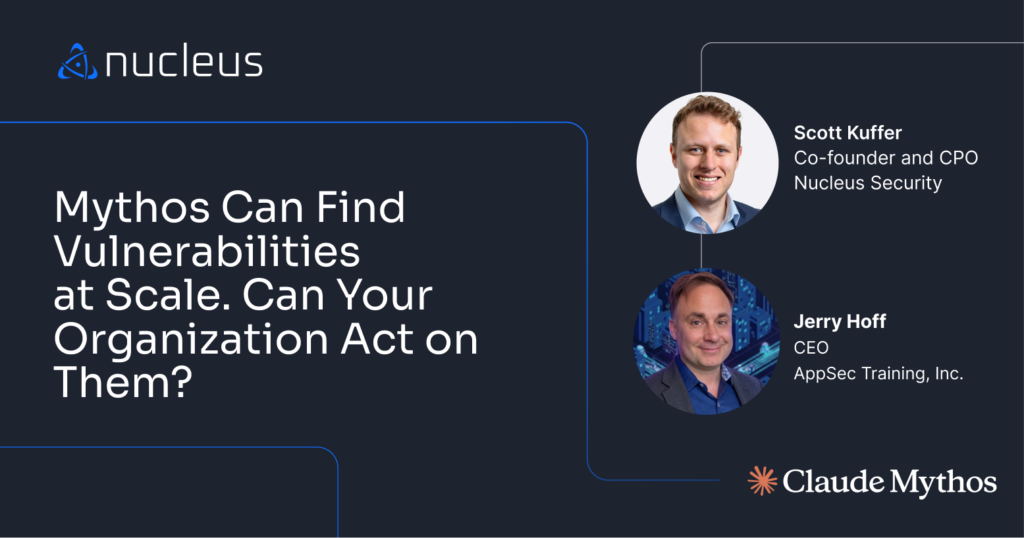



Mythos Can Find Vulnerabilities at Scale. Can Your Organization Act on Them?
Artificial intelligence has rapidly become one of the biggest forces reshaping cybersecurity. But while much of the conversation focuses on AI’s ability to find vulnerabilities, the reality is that most organizations are already managing more vulnerabilities than they can realistically remediate. During this webinar, Jerry Hoff, CEO of AppSec Training, Inc., and Scott Kuffer, CPO and Co-founder at Nucleus Security, explore what AI really means for vulnerability management and why many security teams may be focusing on the wrong problem.
Watch the recording to learn how AI is changing both sides of the cybersecurity equation, why exposure management programs are struggling to keep pace, and what security leaders should prioritize now.
AI Is Accelerating a Problem Security Teams Already Had
For years, organizations have accumulated massive vulnerability backlogs as digital environments expanded across cloud, applications, containers, and infrastructure. The discussion explores why vulnerability discovery has never been the limiting factor and why AI’s ability to uncover even more findings may not be as disruptive as headlines suggest.
Jerry and Scott examine the growing challenge of vulnerability debt, the economics behind remediation, and why many organizations remain unable to address the risks they already know about.
The Emergence of AI-Powered Attackers
Cybercriminals have always benefited from speed and agility. AI may dramatically expand those advantages.
The webinar examines how generative AI and advanced models could enable attackers to analyze data faster, identify exploitable weaknesses more efficiently, and accelerate attack development. The speakers discuss whether security teams should be concerned about autonomous exploitation and where today’s reality sits between marketing hype and genuine risk.
Why Prioritization Remains the Biggest Challenge
When vulnerabilities increase, fixing everything becomes impossible.
One of the most important discussions in the session centers on prioritization. Why do organizations continue to struggle when deciding what to remediate first? What happens when vulnerability volume dramatically increases? And how should organizations think differently about risk-based decision-making?
The conversation offers a practical look at the operational bottlenecks preventing many exposure management programs from achieving better outcomes.
The Gap Between Discovery and Remediation
Security teams have spent decades becoming more effective at finding vulnerabilities. But what happens after discovery?
Jerry and Scott explore the often-overlooked realities of remediation, including ownership challenges, organizational complexity, competing business priorities, and the significant cost associated with fixing vulnerabilities at scale. They discuss why exposure management is ultimately an organizational challenge and not simply a technology problem.
Can AI Help Defenders?
The answer is more nuanced than many vendors suggest.
Rather than replacing security teams, the speakers discuss where AI is delivering meaningful value today: from summarizing information and reducing reporting burdens to improving workflows and user experiences. Just as importantly, they explain where AI still falls short and why human expertise remains essential for security operations and decision-making.
Security Ownership and Accountability in Modern Enterprises
Even the best security program struggles when responsibilities are unclear.
The webinar closes by examining one of the most persistent challenges in cybersecurity: understanding who owns risk and who is responsible for remediation. The discussion highlights why gaining visibility into ownership remains difficult in many organizations and what progress the industry has made in recent years.
Watch the Recording
Whether you’re responsible for vulnerability management, exposure management, application security, or executive cyber risk reporting, this session delivers a thoughtful look at how AI is transforming the security landscape, and what organizations should do next.
TRUSTED BY ORGANIZATIONS WORLDWIDE