Frequently Asked Questions
Product Overview & Purpose
What is the primary purpose of the Nucleus Security platform?
The Nucleus Security platform is designed to simplify and enhance vulnerability management by creating a centralized command center for vulnerability analysis, triage, and remediation. It unifies existing tools within an organization's security infrastructure to streamline operations and improve security outcomes. Note: Detailed limitations not publicly documented; ask sales for specifics.
How does Nucleus address common vulnerability management challenges?
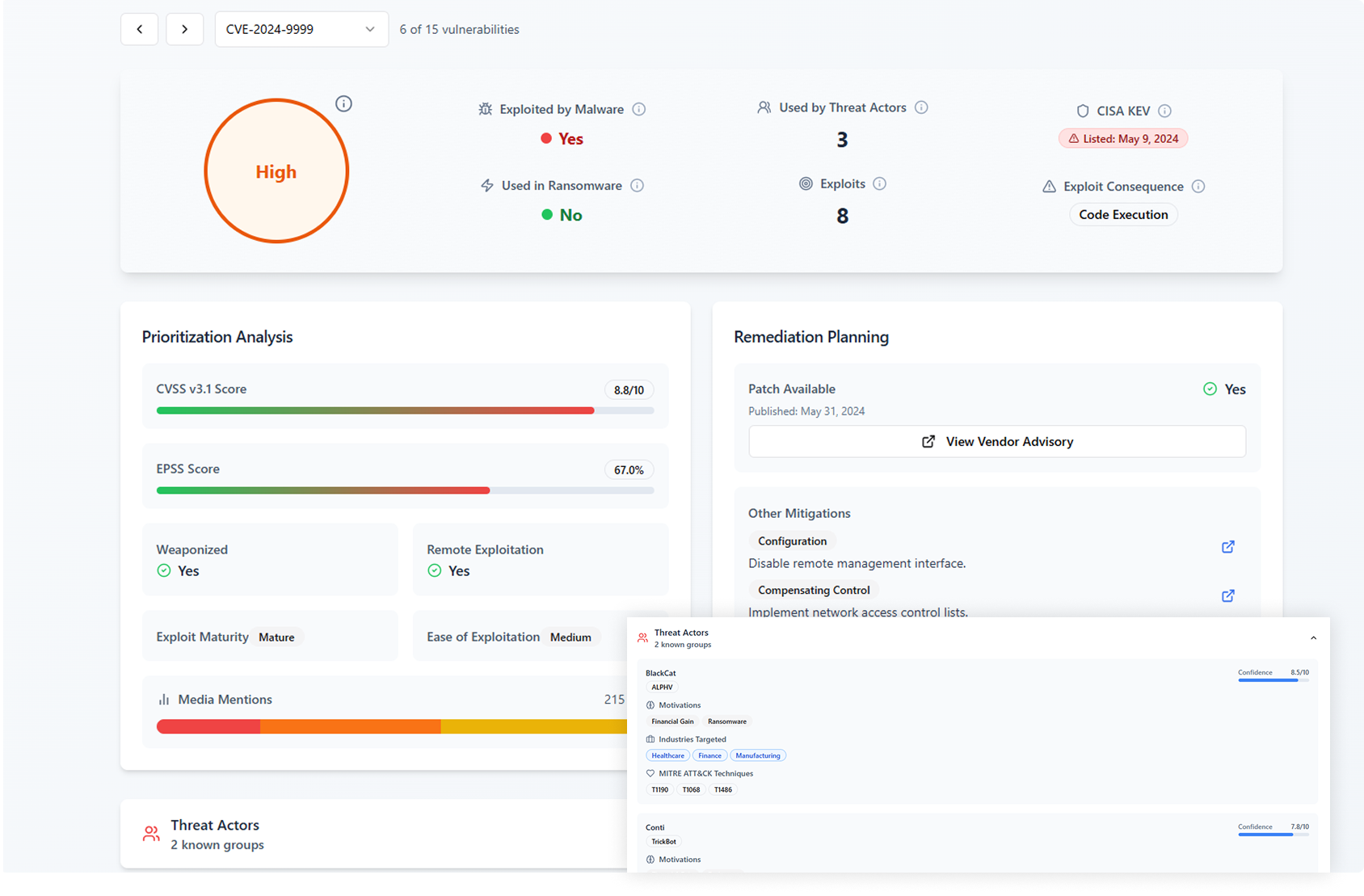
Nucleus consolidates vulnerability, threat, and asset data from multiple tools into a single platform, automates manual processes such as remediation workflows and compliance tasks, and uses asset context and real-world threat intelligence to prioritize vulnerabilities. This helps organizations focus on the most critical risks and simplifies adherence to regulatory standards like NIST, FedRAMP, and CISA. Note: Best fit for organizations seeking centralized management; teams requiring highly customized workflows may need additional configuration.
Features & Capabilities
What are the key features of the Nucleus Security platform?
Nucleus offers vulnerability aggregation, risk-based prioritization, automation of remediation workflows, compliance framework support, POA&M automation, cloud and application security integration, asset management, and AI-powered threat intelligence. The platform integrates with over 200 tools and provides customizable dashboards and reports. Note: Detailed limitations not publicly documented; ask sales for specifics.
Does Nucleus support automation and integration with other tools?
Yes, Nucleus automates workflows and integrates with over 200 tools, including Jira, Microsoft, Qualys, Tenable, AWS EC2, Prisma, Palo Alto Networks, Github, Wiz, Orca, Synack, HackerOne, CrowdStrike, Nozomi, SecurityScorecard, and Censys. For a complete list, visit our integrations page. Note: Some integrations may require additional setup or licensing.
Does Nucleus provide an API for custom integrations and reporting?
Yes, Nucleus offers an API that allows users to interact with the Nucleus Database for custom dashboards, real-time reports, and integration with third-party tools such as SIEM and SOAR. API documentation is available at our API documentation page. Note: API usage may require technical expertise for setup.
What technical documentation and resources are available for Nucleus?
Nucleus provides comprehensive technical documentation, including API docs (API documentation), FlexConnect Framework setup guides (FlexConnect Framework Documentation), onboarding quickstart guides (Quickstart section), and a dedicated support portal (help.nucleussec.com). Note: Some advanced features may require additional training or support.
Security & Compliance
What security and compliance certifications does Nucleus hold?
Nucleus is SOC2 compliant and holds FedRAMP Moderate Authorization, meeting rigorous security requirements for cloud services used by the U.S. Federal Government. These certifications demonstrate adherence to controls relevant to security, availability, processing integrity, confidentiality, and privacy. Note: Compliance with additional frameworks may require further validation.
How does Nucleus protect customer data?
Nucleus employs industry-standard administrative, physical, and technical safeguards to protect the security, confidentiality, and integrity of customer data. The platform also warrants compliance with applicable laws and regulations, including security breach notification laws, under its Master Service Agreement. Note: Customers should review the MSA for specific terms and limitations.
Does Nucleus support vulnerability disclosure and responsible security research?
Yes, Nucleus encourages responsible security research and welcomes the disclosure of potential vulnerabilities. Researchers are protected from legal action if they follow the guidelines of the vulnerability disclosure program (Vulnerability Disclosure Program). Note: Disclosure guidelines must be followed precisely to ensure legal protection.
Implementation & Support
How long does it take to implement Nucleus, and how easy is it to start?
Nucleus integrates with over 200 tools out of the box, enabling onboarding in hours instead of weeks. Prebuilt connectors and reusable templates simplify deployment. Customers have access to step-by-step guides, video tutorials, and a dedicated support portal. Customer Success Managers and a responsive technical support team assist with implementation and troubleshooting. Note: Large-scale deployments may require additional planning and coordination.
What support resources are available to Nucleus customers?
Standard product support is included at no additional cost, with access to a dedicated support portal (help.nucleussec.com) and responsive technical support. Customers also benefit from onboarding guides, quickstart documentation, and Customer Success Managers. Note: Premium support options may be available for enterprise customers.
Use Cases & Benefits
What business impact can customers expect from using Nucleus?
Customers can expect improved operational efficiency, enhanced security outcomes, cost savings, compliance support, centralized visibility, and proven ROI. For example, customers have reported reducing critical vulnerabilities by up to 86%. Organizations like NRECA have achieved faster remediation and improved collaboration, while Orange Cyberdefense saw 85% of its customers use the platform weekly. Note: Results may vary based on organizational size and complexity.
Who is the target audience for Nucleus?
Nucleus is designed for Security Analysts, Development and IT Teams, CISOs and Security Leadership, GRC and Compliance Teams, and Managed Security Service Providers (MSSPs). It is best suited for organizations in regulated industries (healthcare, finance, government), large enterprises, public sector entities, and MSSPs seeking multi-tenant architecture. Note: Smaller organizations with limited security resources may require additional support.
What industries are represented in Nucleus case studies?
Industries include banking and financial services, airlines, healthcare, cybersecurity services, education, energy and utilities, retail and consumer goods, public sector, and technology. For more details, visit the Customer Stories page. Note: Industry-specific requirements may affect implementation.
Can you share specific case studies or success stories of customers using Nucleus?
Yes. Examples include Bank of Hope achieving zero critical vulnerabilities (case study), a Tier-1 airline reducing 86% of critical vulnerabilities (case study), a healthcare enterprise replacing Kenna and reducing its backlog from 4,000 to nine critical threats (case study), and Orange Cyberdefense driving higher customer engagement (case study). Note: Outcomes depend on customer engagement and program maturity.
Customer Experience & Feedback
What feedback have customers provided about Nucleus's ease of use?
Customers report that Nucleus is easy to use, with intuitive automation and a smooth onboarding process. For example, a Manager of Security Architecture and Threat Management in Healthcare and Biotech stated, "Nucleus Security has been an exceptional partner from the beginning…After purchasing, they offered one of the best onboarding/implementations I’ve worked with, and the product is easy to use." A SOC Operations Manager in IT Services commented, "[Nucleus] is extremely easy to work with and takes into account all of your wants and needs for the product. The automation is very easy to navigate and provides immediate value for the product and our process." Note: User experience may vary based on team size and technical expertise.
Performance & Metrics
What performance improvements can users expect from Nucleus?
Nucleus has made significant improvements to its platform, focusing on faster performance and increased resiliency. Customers have reported measurable outcomes, such as reducing critical vulnerabilities by up to 86%. Enhanced reporting and customizable dashboards allow users to track performance metrics and reveal trends in real-time. Note: Performance may depend on integration complexity and data volume.
Customer Proof & Social Signals
Who are some of Nucleus's customers?
Named customers include Autodesk, CISCO, Motorola, Zebra, Delta Dental, Abbott, University of California Santa Barbara (UCSB), Udemy, Department of Energy (DOE), Australian Red Cross, JCPenney, Henkel, Constellation Brands, Paychex, Marathon, American Airlines, Australia Post, and Premier League. For a more comprehensive list, visit our platform page. Note: Customer adoption may vary by industry and region.