













Nucleus Helix Was Built to Fix Exposure Management’s Breaking Point

Let me be direct about something the industry keeps dancing around: the vulnerability problem isn’t getting better. It’s getting structurally worse. The wave of AI-generated code and compression of time to exploit thanks to frontier AI models like Mythos is about to make “worse” look quaint.
If your vulnerability and exposure management program is still built around scanner cycles, ticket queues, and CVSS scores, you’re not running a security program. You’re running a backlog management system. And the backlog just hired a rocket scientist.
The Numbers Don’t Lie, But They Should Terrify You
CVE volume has been climbing for years. We first crossed the threshold of 25,000 CVEs published in a year in 2022; in 2025, that number approached 50,000. We’re now in a world where AI-assisted development accelerates code production, and AI-assisted vulnerability research accelerates discovery. The compounding effect is not linear. We are entering an era where the raw volume of disclosed vulnerabilities will outpace any team’s ability to manually triage them, full stop.
This isn’t a headcount problem. Hiring more analysts doesn’t solve a structural mismatch between the speed of discovery and the speed of response. Absolutely, bringing in more people can help in the short term, but the only lasting solution is building durable, repeatable, and automatable program logic that operates faster than any human workflow can.
More AI isn’t the answer either; at least not the way most organizations are treating it. AI can create leverage, search data, analyze trends, reason through complex exposure questions, and build the logic an exposure management program needs to operate. AI that operates your security program, however, is a liability disguised as a feature.
AI Doing the Work vs. AI Building the Program
There’s a seductive story being sold right now. It goes like this: give an AI agent access to your vulnerability data, your ticketing system, and your patch tools. Then let it run.
The promise? Autonomous remediation. Self-healing security. Hands off the wheel.
I understand the appeal. I really do. When a team of six analysts is staring down 80,000 open findings, anything that promises to shrink that number sounds like salvation.
But let me tell you what I’ve seen in practice. AI agents operating directly in production environments introduce a category of risk that most security leaders haven’t fully priced in: execution uncertainty. LLMs are probabilistic. They reason, they infer, and they occasionally hallucinate. Those are features when you’re drafting a summary or investigating a threat. They are dangerous properties when you’re automatically pushing a patch to a production server or closing a finding that isn’t remediated.
Deterministic automation — the kind built on explicit logic, defined rules, and approved workflows — doesn’t have opinions, and it doesn’t improvise. It executes exactly what you told it to, every time, reliably. That’s what you want operating your production environment.
The right model isn’t AI doing the work. It’s AI building the program logic that deterministic automation then executes at scale. AI helps you construct the dashboards, write the queries, define the ownership models, and design the remediation workflows. Then your automation runs them reliably, repeatedly, without variance.
That’s the distinction that matters. And it’s the one the market has almost entirely missed.
Why We Built Nucleus Helix
The volume problem, the AI execution risk, the prioritization gap, everything I described above, shaped how we thought about what Nucleus Helix needed to be.
Nucleus Helix is our AI foundation for exposure management. It is explicitly not an autonomous agent operating your security program. It is AI applied where it creates real leverage: helping teams build better program logic. Natural language queries against your unified exposure data. AI-generated NQL to surface the findings that matter. Dashboard creation through plain language. It’s the groundwork for AI-assisted workflows, ownership models, and remediation plans that your deterministic automation then executes without variance.
At the same time, we shipped Nucleus Discover’s early warning capabilities because scanner cycles are a lagging indicator in a world where zero-days move in hours, not days. By combining real-time agentic vulnerability intelligence with your known asset context, we can help you determine whether a newly disclosed issue touches your environment before your scanner has a signature for it. That’s not a minor operational improvement. In the right situation, that’s the difference between early response and incident response.
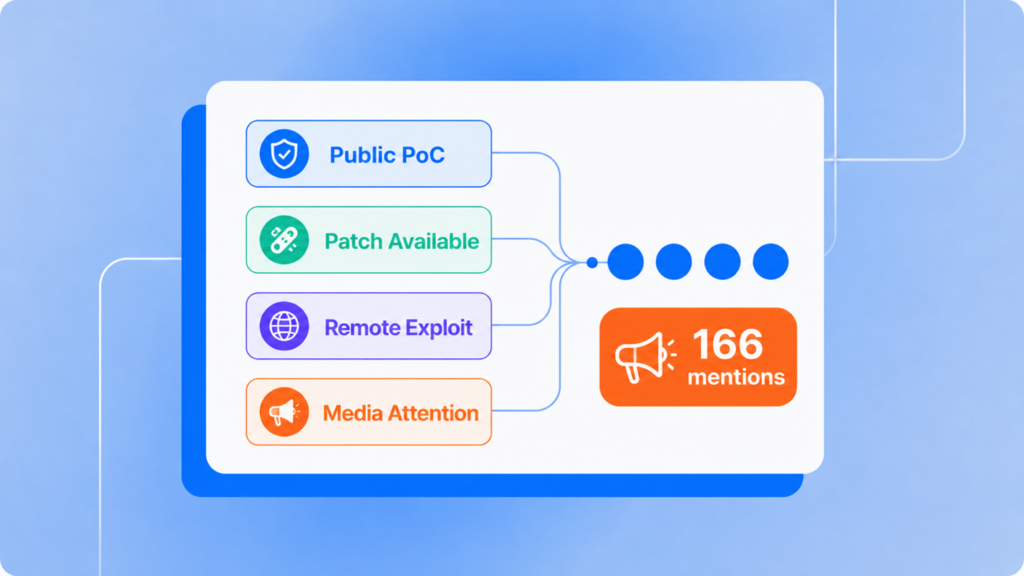
We also expanded Nucleus Insights with operational intelligence that should change how your team routes work: end-of-life OS detection, vulnerability-type routing, Patch Tuesday intelligence baked into your workflow, CISA SSVC fields embedded in your findings. This is prioritization infrastructure. It’s the kind that lets your team stop making the same triage decisions manually, repeatedly, and start trusting a system to route risk correctly.
The Program Is the Differentiator
I’ve been in this space long enough to watch the pendulum swing between tool sprawl and consolidation, between manual process and automation, between data-rich and context-poor. The teams that are winning today aren’t winning because they have more scanners. They’re winning because they built a coherent, durable, and scalable program on top of their data.
That program is increasingly the differentiator between organizations that manage exposure and organizations that manage anxiety.
Nucleus Helix is the next step in our vision for what that program looks like: AI helping teams build better logic, deterministic automation executing it reliably, and unified data grounding every decision in actual context.
The flood isn’t slowing down. But you can build a better boat. And that’s why we built Nucleus Helix.

See Nucleus in Action
Discover how unified, risk-based automation can transform your vulnerability management.