
















Understanding and Navigating the Requirements of CISA BOD 26-04
CISA Binding Operational Directive 26-04: Prioritizing Security Updates Based on Risk requires Federal Civilian Executive Branch (FCEB) agencies to prioritize security updates based on operational risk, not just severity. It builds on earlier Cybersecurity and Infrastructure Security Agency (CISA) directives by combining exposure, exploitation, impact, and prioritization logic into a more actionable remediation model. Previous CISA directives specified KEV-driven remediation requirements and stronger asset visibility.
Today, the time defenders have to react between vulnerability discovery and exploit has been compressed as threat actors leverage AI. In response, CISA BOD 26-04, Prioritizing Security Updates Based on Risk, gives FCEB agencies a more structured way to decide which vulnerabilities require the fastest action. The directive shifts the focus from treating every patch as equally urgent to prioritizing vulnerabilities based on risk signals that are more closely tied to exploitation potential and agency exposure.
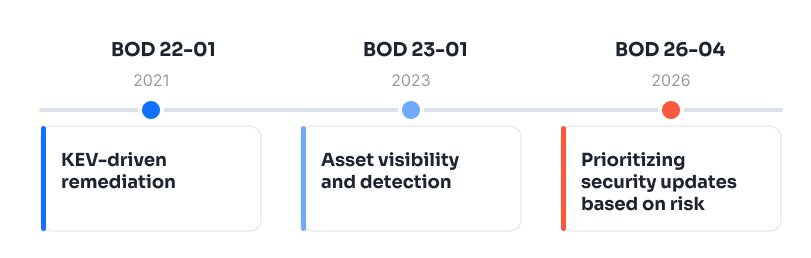
For readers who want broader policy context first, review CISA’s previous directives: BOD 22-01 on KEV-driven remediation, and BOD 23-01 on asset visibility and vulnerability detection.
Who Does BOD 26-04 Apply To?
BOD 26-04 applies to Federal Civilian Executive Branch agencies under CISA’s directive authority. For official scope references, see CISA’s Cybersecurity Directives overview and the Federal Civilian Executive Branch agencies list.
Although the directive is binding on FCEB agencies, it is also useful guidance for state, local, education, critical infrastructure, and private-sector organizations that want a more defensible risk-based remediation model.
What Does CISA BOD 26-04 Require?
We lay out the requirements of CISA BOD 26-04 elsewhere, but to reiterate the requirements here, it directs agencies to prioritize remediation using four decision criteria:
- Is the affected asset publicly exposed?
- Can exploitation be fully automated?
- Would exploitation allow the attacker to take full control of the affected system?
- Is there evidence of active exploitation?
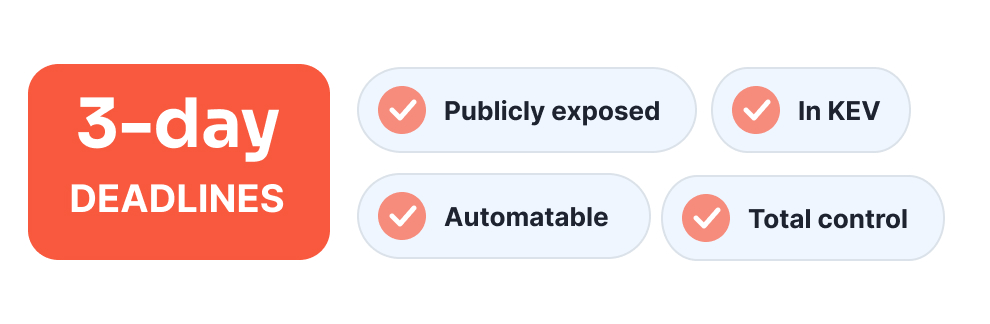
The highest-priority vulnerabilities that meet all four conditions must be remediated within three days. The directive also requires forensic triage to help determine whether affected systems may already have been compromised.
The directive establishes implementation milestones, including policy and process updates, before agencies begin operating against the new remediation timelines.
What Is the 3-Day Deadline in BOD 26-04?
The three-day deadline applies to the vulnerabilities CISA considers most urgent under the directive’s risk model. In practical terms, that means vulnerabilities where public exposure, exploitability, automation potential, and impact combine to create the highest operational risk.
This is one of the biggest shifts in BOD 26-04. CISA is not simply asking agencies to patch faster across the board. It is telling them to move fastest on the vulnerabilities most likely to become breaches.
How Does BOD 26-04 Fit with Earlier CISA BODs?
BOD 26-04 is easier to understand in the context of CISA’s earlier directives. BOD 22-01 said agencies must move quickly on vulnerabilities known to be exploited. BOD 23-01 said agencies need better visibility into what they own and what is exposed. BOD 26-04 brings those ideas together into a more operational prioritization model.
- BOD 22-01 established the requirement for FCEB agencies to remediate vulnerabilities in CISA’s Known Exploited Vulnerabilities (KEV) Catalog within prescribed timeframes.
- BOD 23-01 focused on improving asset visibility and vulnerability detection across federal networks.
- BOD 26-04 builds on both by telling agencies how to prioritize broader security updates when multiple remediation demands compete for limited time and resources.
Why Speed and Automation Matter More in BOD 26-04
AI is changing attacker economics. It can accelerate exploit research, reduce the effort needed to operationalize attacks, and increase the volume of vulnerabilities that can be turned into real-world exploitation. CISA is responding to those changing market dynamics by placing more weight on signals like public exposure and automatable exploitation, which are more closely tied to operational risk than severity alone.
CISA BOD 26-04 reflects a practical shift in the vulnerability landscape: agencies are dealing with more security updates, more exposed assets, and less time to make the right remediation decision. Manual triage does not scale when vulnerability volume keeps rising and the window between disclosure and exploitation keeps shrinking.
For agencies, the real challenge is operationalizing risk-based remediation at scale. Prioritization decisions depend on vulnerability data, accurate asset context, threat intelligence, ownership, and mission relevance. As vulnerability volumes grow and remediation timelines tighten, organizations need automated workflows that can rapidly translate risk signals into action with speed, consistency, and measurable outcomes.
How Teams Should Operationalize SSVC for BOD 26-04
Stakeholder-Specific Vulnerability Categorization (SSVC) offers an established, known framework agencies can use to meet BOD 26-04’s requirements.
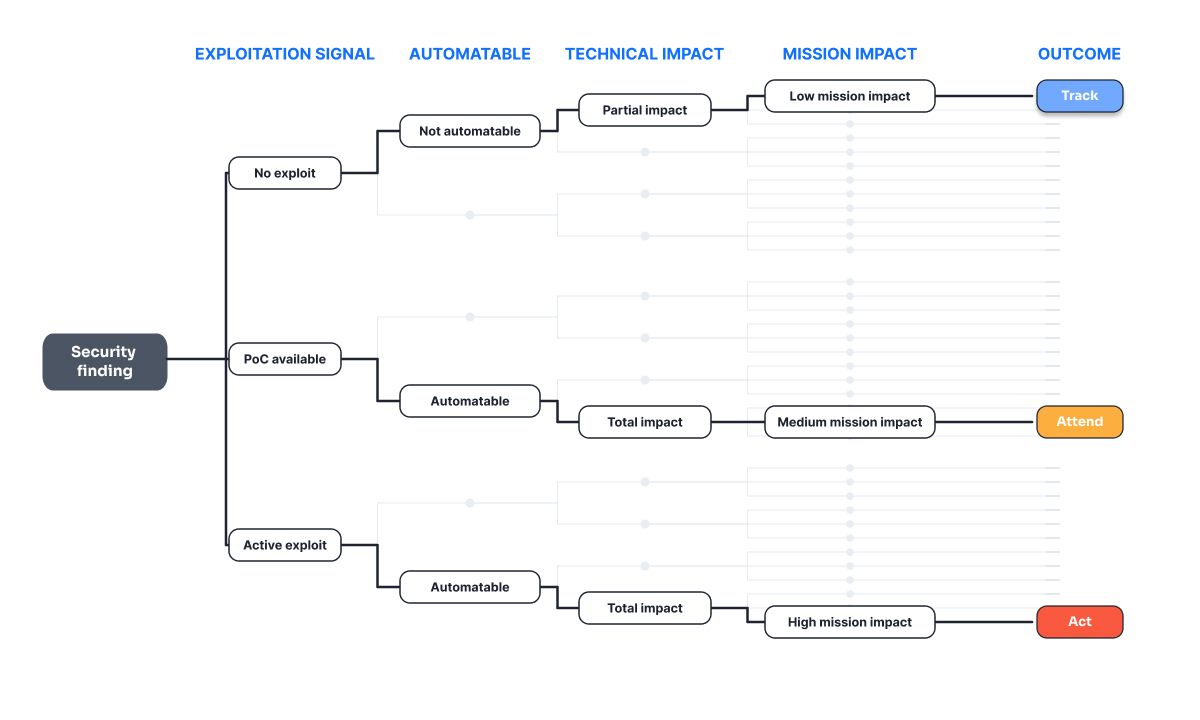
A practical way to operationalize SSVC is to treat it as a decision layer that sits on top of existing vulnerability, asset, and threat intelligence workflows. Teams should structure SSVC around four core inputs that align closely to BOD 26-04 decision-making:
- Exploitation — Whether there is no known exploitation, a public proof of concept, or active exploitation
- Automatable — Whether exploitation can be reliably automated
- Technical Impact — Whether exploitation leads to partial or total control of the affected system
- Mission and Well-Being — The importance of the affected asset or system to agency operations and mission continuity
Step 1: Normalize the Underlying Data
SSVC only works when teams can consistently pull the right data into one workflow. That means vulnerability findings, asset metadata, exposure status, KEV status, exploit intelligence, and ownership all need to be connected and normalized before prioritization begins.
For agencies responding to BOD 26-04, this includes making sure teams can identify whether an asset is public-facing, whether a vulnerability is actively exploited, and whether the affected system is mission-essential.
Step 2: Map SSVC Inputs to Operational Values
Teams can translate SSVC decision inputs into structured values that support consistent prioritization. A practical operating model uses these input sets:
- Exploitation: none, public PoC, active
- Automatable: no, yes
- Technical Impact: partial, total
- Mission and Well-Being: low, medium, high
This creates a practical way to classify vulnerabilities using operationally meaningful criteria instead of severity alone.
Step 3: Convert SSVC Outcomes into Actionable Priority Bands
The goal is not to create another abstract score. The goal is to drive operational decisions by mapping into clear actions:
- Track
- Attend
- Act
Step 4: Assign BOD-aligned SLA Timeline Automations
SSVC prioritization outcomes are translated into CISA’s specific remediation timelines based on four inputs:
- Publicly exposed?
- In the KEV?
- Automatable by adversary?
- Technical impact?
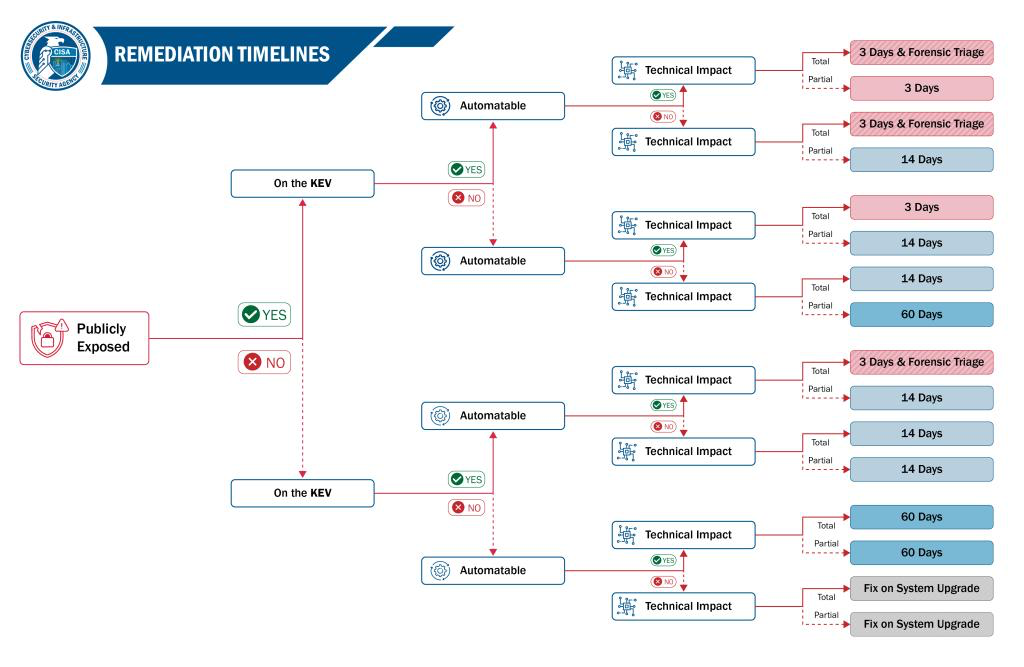
CISA BOD 26-04 Remediation Timeline Table
| Publicly Exposed | In KEV | Automatable | Technical Impact | BOD 26-04 Remediation Timeline |
|---|---|---|---|---|
| Yes | Yes | Yes | Total control | 3 days + forensic triage |
| Yes | Yes | Yes | Partial control | 3 days |
| Yes | Yes | No | Total control | 3 days + forensic triage |
| Yes | Yes | No | Partial control | 14 days |
| Yes | No | Yes | Total control | 3 days |
| Yes | No | Yes | Partial control | 14 days |
| Yes | No | No | Total control | 14 days |
| Yes | No | No | Partial control | 60 days |
| No | Yes | Yes | Total control | 3 days + forensic triage |
| No | Yes | Yes | Partial control | 14 days |
| No | Yes | No | Total control | 14 days |
| No | Yes | No | Partial control | 14 days |
| No | No | Yes | Total control | 60 days |
| No | No | Yes | Partial control | 60 days |
| No | No | No | Total control | Fix on system upgrade |
| No | No | No | Partial control | Fix on system upgrade |
How to Use the Table Operationally
Teams should use the decision inputs to drive policy-backed workflow outcomes.
A practical implementation looks like this:
- Map Exploitation, Automatable, Technical Impact, and Mission and Well-Being into a normalized decision model.
- Use public exposure and KEV presence as additional routing and escalation inputs aligned to the BOD timeline.
- Translate the output into internal workflow states such as Act, Attend, and Track.
- Connect those states to due dates, escalation rules, ticket routing, and reporting.
For example:
- Vulnerabilities that align to the most urgent BOD combinations, such as internet-facing + KEV + total control, should route into the fastest response path and include forensic triage requirements where applicable.
- Vulnerabilities that fall into the 14-day or 60-day tiers should still receive automated ownership, tracking, and deadline enforcement.
- Lower-priority vulnerabilities that map to fix on system upgrade should remain visible for lifecycle planning and auditability.
These remediation timelines are also laid out on this graphic provided by CISA:
Step 5: Use Mission Context as a Policy Input
One of the most important lessons in applying SSVC is that mission context needs to be explicit. In practice, this means mapping asset criticality, system function, or mission-essential designations into the SSVC decision process.
For federal teams, this is what makes SSVC useful. It allows the same vulnerability to be treated differently depending on the operational role of the affected asset.
Step 6: Keep Reporting and Explainability Intact
SSVC must remain explainable. Teams should be able to show which inputs drove the decision, how that decision mapped to remediation urgency, and why a vulnerability was assigned a given timeline.
That matters for BOD 26-04 because prioritization is not just a technical queue-management exercise. It is a governance and accountability requirement.
For deeper background, see CISA’s SSVC overview, the CISA SSVC guide, and the SSVC calculator.
What Organizations Need to Operationalize BOD 26-04
For agencies and organizations building mature exposure management programs, BOD 26-04 reinforces the importance of:
- Centralized vulnerability and asset data
- Continuous enrichment with threat intelligence
- Risk-based prioritization workflows
- Clear remediation ownership
- Timely reporting and auditability
Helpful Nucleus Resources
- Nucleus for Federal Government
- Exposure Management use case
- CISA KEV prioritization use case
- Nucleus Insights
- Nucleus Vulnerability Intelligence Platform
- Unified Vulnerability Management
- Vulnerability Management platform
- Operational Efficiency in Federal Vulnerability Management
- Nucleus for Civilian Government Agencies
Frequently Asked Questions About CISA BOD 26-04
What is CISA BOD 26-04 in simple terms?
CISA BOD 26-04 is a CISA directive that tells FCEB agencies to prioritize security updates based on risk signals such as exposure, exploitability, impact, and evidence of exploitation, rather than relying on severity alone.
Who must comply with BOD 26-04?
Federal Civilian Executive Branch (FCEB) agencies and FedRAMP Cloud Security Providers (CSPs) must comply with CISA BOD 26-04. Other organizations can still use the directive as a practical model for risk-based remediation.
How is BOD 26-04 different from BOD 22-01?
BOD 22-01 focuses on remediating vulnerabilities listed in the KEV Catalog within defined deadlines. BOD 26-04 is broader: it defines a prioritization model for security updates based on multiple risk criteria.
How is BOD 26-04 different from BOD 23-01?
BOD 23-01 focuses on asset visibility and vulnerability detection. BOD 26-04 focuses on deciding which security updates should move first once agencies have that visibility.
Does BOD 26-04 apply outside of the federal government?
No, BOD 26-04 is binding on FCEB agencies and FedRAMP CSPs only. However, the directive is still useful guidance for organizations that want a more mature, risk-based remediation program.

See Nucleus in Action
Discover how unified, risk-based automation can transform your vulnerability management.