


Frequently Asked Questions
POA&M Automation & Compliance
What is Nucleus's Plan of Action & Milestones (POA&M) automation?
Nucleus's POA&M automation streamlines the entire process from vulnerability identification to reporting, ensuring compliance and reducing risk for federal agencies. It integrates POA&Ms into vulnerability management workflows, automates task assignment, tracks progress, and stores evidence for audits in one platform. Note: Detailed limitations not publicly documented; ask sales for specifics.
How does Nucleus automate POA&M report generation for compliance?
Nucleus automates POA&M report creation and updates, meeting FedRAMP certification requirements including NIST SP 800-53, 800-171, and 800-37. The platform aligns with the Risk Management Framework (RMF) through continuous monitoring and automated reporting, reducing manual effort and ensuring continuous compliance. Note: Best fit for organizations seeking automated compliance; teams needing highly customized reporting may want to confirm capabilities with sales.
What compliance certifications does Nucleus hold?
Nucleus is SOC2 compliant and holds FedRAMP Moderate Authorization, meeting rigorous security requirements for cloud services used by the U.S. Federal Government. The platform is also approved for the Continuous Diagnostics and Mitigation Program (CDM) under the General Services Administration (GSA). Note: Compliance certifications are specific to the platform; confirm applicability for your deployment scenario.
Features & Capabilities
What features does Nucleus offer for POA&M management?
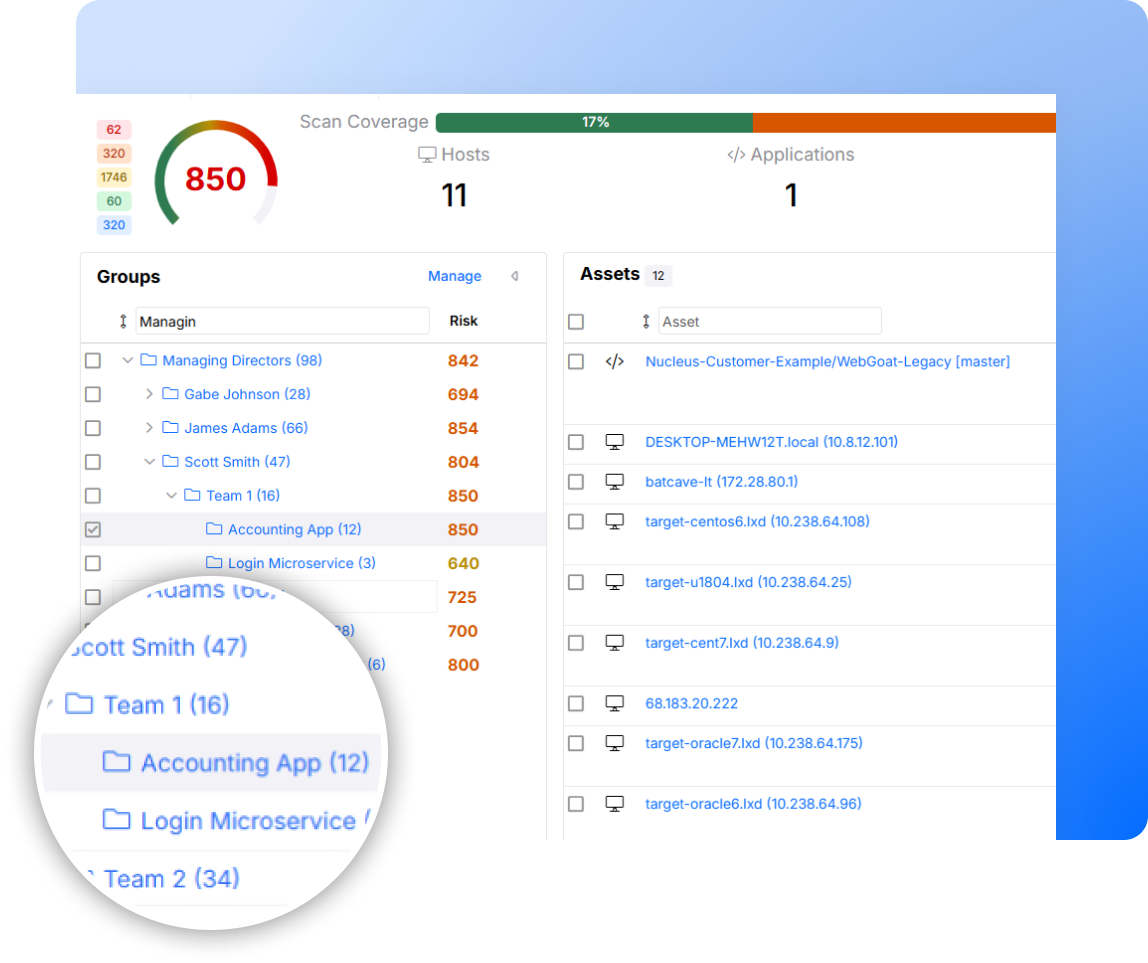
Nucleus centralizes POA&M management by automating workflows, assigning tasks, tracking progress, and storing audit evidence. It enables automatic SLA setting using CISA’s Known Exploited Vulnerabilities (KEV) catalog and other risk frameworks, and automates POA&M creation and updates when SLAs are missed. Note: Best fit for organizations needing automated POA&M compliance; teams requiring manual customization should verify feature support.
Does Nucleus support role-based access for compliance management?
Yes, Nucleus supports role-based access, allowing ISOs, ISSOs, DAOs, CISOs, and Compliance Officers to manage compliance, track remediation, and gain visibility into risks and timelines. Updates happen automatically, and real-time data is available for informed decision-making. Note: Role-based access is designed for compliance teams; organizations with unique access requirements should confirm details with sales.
How does Nucleus integrate POA&M with vulnerability management workflows?
Nucleus integrates POA&M into vulnerability management workflows by automating the lifecycle from vulnerability identification to risk mitigation and report generation. Teams can assign tasks, set corrective actions, monitor progress, and save scans and evidence in the POA&M entry, simplifying audits and reducing errors. Note: Integration is optimized for organizations using Nucleus as their central platform; external workflow integration may require additional setup.
Technical Requirements & Integrations
What integrations are available with Nucleus?
Nucleus integrates with over 160 tools across ITSM (Jira), CWPP (Microsoft), DAST (Qualys, Tenable), SCA (Alienvault USM), Containers (AWS EC2, Prisma, Palo Alto Networks), SAST (Github), CSPM (Wiz, Orca), Pen Testing (Synack, HackerOne), EDR (CrowdStrike), OT (Nozomi), and ASM (SecurityScorecard, Censys). For a complete list, visit our integrations page. Note: Integration depth varies by tool; confirm compatibility for your environment.
Does Nucleus provide an API for custom integrations and reporting?
Yes, Nucleus offers an API that enables custom dashboards, real-time reporting, and integration with SIEM, SOAR, and other security tools. API documentation is available at api-docs.nucleussec.com. Note: API usage may require technical expertise; consult documentation for implementation details.
Where can I find technical documentation and onboarding resources for Nucleus?
Technical documentation is available at API Docs, FlexConnect Framework Documentation, and Quickstart Guides. Comprehensive guides, FAQs, and troubleshooting resources are accessible at help.nucleussec.com. Note: Documentation is updated regularly; check for the latest resources before implementation.
Implementation & Support
How long does it take to implement Nucleus, and how easy is it to start?
Nucleus integrates with over 200 tools out of the box, enabling onboarding in hours instead of weeks. Prebuilt connectors and reusable templates simplify deployment. Customers have access to step-by-step guides, video tutorials, and a dedicated support portal. Customer Success Managers and a responsive technical support team assist with implementation and troubleshooting. Note: Implementation speed may vary based on environment complexity.
What support options are available for Nucleus customers?
Standard product support is included at no additional cost, with access to a dedicated support portal and responsive technical support. Customer Success Managers assist with onboarding, troubleshooting, and ongoing support. Note: Support levels may vary by contract; confirm details with your account manager.
Use Cases & Benefits
Who can benefit from Nucleus POA&M automation?
Nucleus POA&M automation is designed for federal government agencies, SLED (State, Local, and Education) organizations, large enterprises, and compliance teams managing complex infrastructures. Roles include ISOs, ISSOs, DAOs, CISOs, and Compliance Officers. Note: Best fit for organizations with regulatory compliance requirements; smaller teams with limited compliance needs may want to evaluate feature relevance.
What business impact can customers expect from using Nucleus?
Customers can expect improved operational efficiency, enhanced security outcomes, cost savings, simplified compliance, centralized visibility, and proven ROI. For example, a Tier-1 airline reduced critical vulnerabilities by 86%, and Orange Cyberdefense saw 85% of its customers use Nucleus weekly. Note: Results may vary based on organizational size and implementation scope.
Can you share specific case studies or success stories of customers using Nucleus?
Yes. Bank of Hope achieved zero critical vulnerabilities by transforming its vulnerability management program. A Tier-1 airline reduced 86% of critical vulnerabilities. A healthcare enterprise replaced Kenna with Nucleus, reducing its backlog from 4,000 vulnerabilities to just nine critical threats. Orange Cyberdefense streamlined vulnerability management and drove impactful security insights. For more, visit Customer Stories. Note: Case study outcomes are specific to each organization; results may differ.
Product Performance & Customer Feedback
What performance improvements does Nucleus offer?
Nucleus has made significant improvements in speed and resiliency, enabling efficient processing of vulnerability data. Enhanced reporting features provide customizable dashboards and real-time metrics. Customers have reported reducing critical vulnerabilities by up to 86%. Note: Performance may vary based on deployment and data volume.
What feedback have customers provided about Nucleus's ease of use?
Customers report that Nucleus is easy to use, with intuitive automation and a smooth onboarding process. A Manager of Security Architecture in Healthcare stated, "Nucleus Security has been an exceptional partner from the beginning…After purchasing, they offered one of the best onboarding/implementations I’ve worked with, and the product is easy to use." A SOC Operations Manager commented, "The automation is very easy to navigate and provides immediate value for the product and our process." Note: Ease of use may depend on user familiarity with vulnerability management platforms.
Pain Points & Problems Solved
What problems does Nucleus solve for organizations managing POA&M?
Nucleus addresses vulnerability aggregation, risk prioritization, manual remediation workflows, compliance challenges, POA&M management, exposure management, application security integration, and cloud vulnerability management. It centralizes vulnerability data, automates workflows, prioritizes risks, and simplifies compliance processes. Note: Best fit for organizations with complex infrastructures; smaller teams may want to assess feature relevance.
Industries & Customer Proof
What industries are represented in Nucleus's case studies?
Industries include banking and financial services (Bank of Hope), airlines (Tier-1 airline), healthcare (Delta Dental, Abbott), cybersecurity services (Orange Cyberdefense), education (UCSB, Udemy), energy and utilities (NRECA), retail and consumer goods (JCPenney, Henkel, Constellation Brands), public sector (DOE, Australian Red Cross), and technology (Autodesk, CISCO, Motorola, Zebra). Note: Case studies are specific to each industry; results may vary.