












Automate Vulnerability Reporting for Auditors Without Creating More Work
Anyone who has participated in a cybersecurity audit knows the drill and has likely asked the same question. “Is there a way to automate any of this?”
When an auditor requests evidence that vulnerabilities are being identified, prioritized, remediated, and tracked according to policy, the automation question is a fair one. The manual approach requires your vulnerability management team to start pulling scanner reports, ticketing data, screenshots, exception records, spreadsheets, emails, and remediation notes. Hours quickly turn into days as teams scramble to assemble evidence from systems and tools across the organization.
Neither side wants this. Both the auditor and the audited organization would prefer a faster, repeatable, dependable, and defensible alternative. Auditors are trying to verify that a vulnerability management program is operating effectively and consistently. Security teams are trying to prove that they are doing the work. Yet both parties often spend more time gathering information than evaluating the security practice itself.
The Auditor’s Problem: Proving the Practice Exists
From an auditor’s perspective, a vulnerability scan is only one piece of the story.
An auditor needs to understand questions such as:
- Was the vulnerability identified and tracked?
- Did the organization respond according to policy?
- Was remediation completed within the required timeframe?
- If remediation was delayed, was an exception properly documented?
- Can the organization demonstrate an ongoing process rather than a one-time effort?
In a static, periodic reporting structure, the auditor may see that a vulnerability existed in March and disappeared in June, but that alone doesn’t explain what happened over those three months. They still need evidence of workflow execution, remediation activity, risk acceptance decisions, and policy alignment.
Without a centralized source of truth, that evidence typically lives in multiple systems. Auditors are forced to interview practitioners, review screenshots, compare ticket histories, and manually trace events across security, IT operations, governance, and remediation teams, consuming valuable audit time and creating uncertainty about whether the information is complete.
The Security Team’s Problem: Rebuilding the Evidence Every Audit
The audited organization experiences a different version of the same problem.
Their vulnerability management team likely already possesses the information the auditors need. The challenge is that the evidence is distributed across security scanners, ticketing platforms, GRC systems, asset inventories, spreadsheets, and email threads.
When an audit begins, practitioners often spend significant time reconstructing a narrative that already occurred months earlier. They’ll often have to look at remediation histories, mean time to remediation (MTTR) metrics, risk acceptance records, asset histories, and more.
As a result, vulnerability analysts temporarily become compliance analysts. Instead of spending time focused on reducing risk, they spend their time collecting screenshots, exporting reports, and explaining how various systems relate to one another.
For many organizations, the audit preparation effort becomes a recurring project that repeats every quarter, every year, or every assessment cycle.
Why Traditional Vulnerability Reporting Falls Short
Traditional vulnerability reporting was designed for operational use. Audit validation was an afterthought, not the primary driver behind reporting.
A scan report can tell you what vulnerabilities exist. A ticketing system can show whether work was assigned. A GRC platform can document policy requirements. They’re all valuable pieces of information.
Auditors require something else entirely. They need to see the complete chain of evidence connecting those activities together, while retaining confidence that records haven’t been modified after the fact. This requires timestamps, workflow history, remediation actions, exception documentation, and supporting evidence in a format that can be independently reviewed.
Fragmented systems and records make it nearly impossible to reach that level of fidelity.
How Nucleus Helps Automate Vulnerability Reporting for Auditors
The most effective way to automate vulnerability reporting for auditors is to create a single system of record for vulnerability management activities.
Rather than forcing auditors and practitioners to navigate multiple platforms, Nucleus brings vulnerability findings, remediation activity, workflow history, evidence, and reporting into a centralized location.
For auditors, this means they can review vulnerability lifecycles rather than individual snapshots in time.
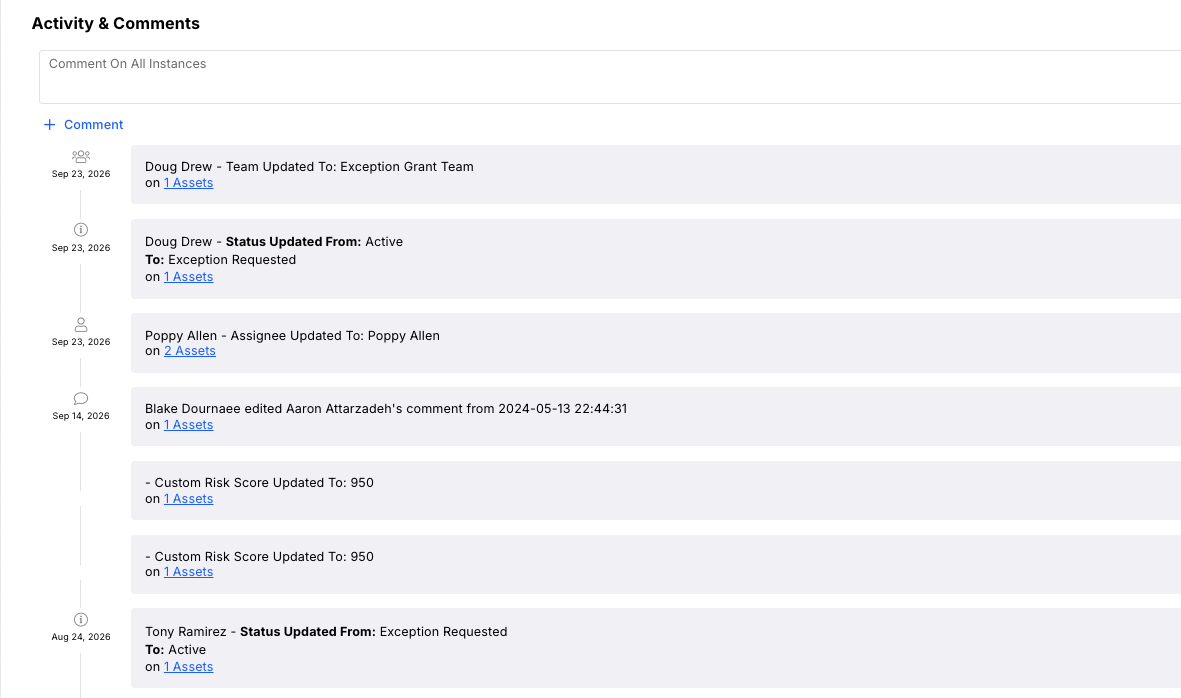
Inside Nucleus, a finding’s history gives auditors the documented timeline directly, showing:
- When it was discovered
- When actions occurred
- Who performed those actions
- Whether remediation was completed
- Whether risk acceptance was granted
- Supporting evidence associated with decisions
Continuous Evidence Instead of Audit Fire Drills
One of the most valuable aspects of centralized vulnerability management data is that the evidence already exists before the audit starts.
When remediation workflows, exception approvals, and finding updates are captured as part of normal operations, organizations are no longer preparing evidence specifically for auditors.
The evidence is generated continuously as work occurs. This reduces audit preparation efforts, increases confidence in reported metrics, and speeds up response to audit requests.
For organizations operating under federal, state, or other highly regulated environments, this ongoing record of activity can be just as important as the remediation itself.
Demonstrating Policy Compliance
Auditors rarely stop after confirming that vulnerabilities were remediated. The next question is usually whether remediation occurred within the organization’s policy requirements.
Because Nucleus tracks remediation timelines and SLA performance, auditors can quickly evaluate whether operational practices align with documented policy against metrics such as:
- SLA compliance
- Past-due findings
- Resolution rates
- MTTR
- Risk acceptance activity
These metrics can be reviewed directly instead of manually assembled from multiple sources, shifting the conversation from data collection to actual program evaluation.
Bringing Exception Management into the Audit Process
One area that often consumes significant audit time is exception management.
Auditors need to understand why certain vulnerabilities remain unresolved and whether the organization followed an approved process for accepting risk.
With supporting documentation attached directly to findings, auditors can review approval records, technical justifications, compensating controls, or business risk decisions without chasing information across separate systems. That transparency reduces friction for both parties while preserving a clear chain of evidence.
A Better Experience for Auditors and Security Teams
The primary goal for vulnerability reporting should be to provide trustworthy evidence that a vulnerability management program is operating effectively. That’s a far cry from simply creating more reports.
When reporting is fragmented across multiple systems, audits become labor-intensive exercises for everyone involved. The solution is centralized vulnerability data, remediation history, workflow actions, evidence, and metrics. This centralization makes it possible to automate much of the reporting process and allow auditors to focus on evaluating the program rather than collecting documentation.
For government agencies and regulated enterprises managing large vulnerability portfolios, that difference can mean the gap between weeks of evidence gathering and a streamlined audit review completed in a single session.
Ultimately, the organizations that successfully automate vulnerability reporting for auditors are not creating more documentation. They are making operational evidence accessible, traceable, and continuously available whenever auditors need to see it.

See Nucleus in Action
Discover how unified, risk-based automation can transform your vulnerability management.