
















COMPLIANCE FRAMEWORKS
Align Your Program with Key Frameworks
Meet the security industry’s most trusted and recognized compliance frameworks and standards.


FILTER BY FRAMEWORK
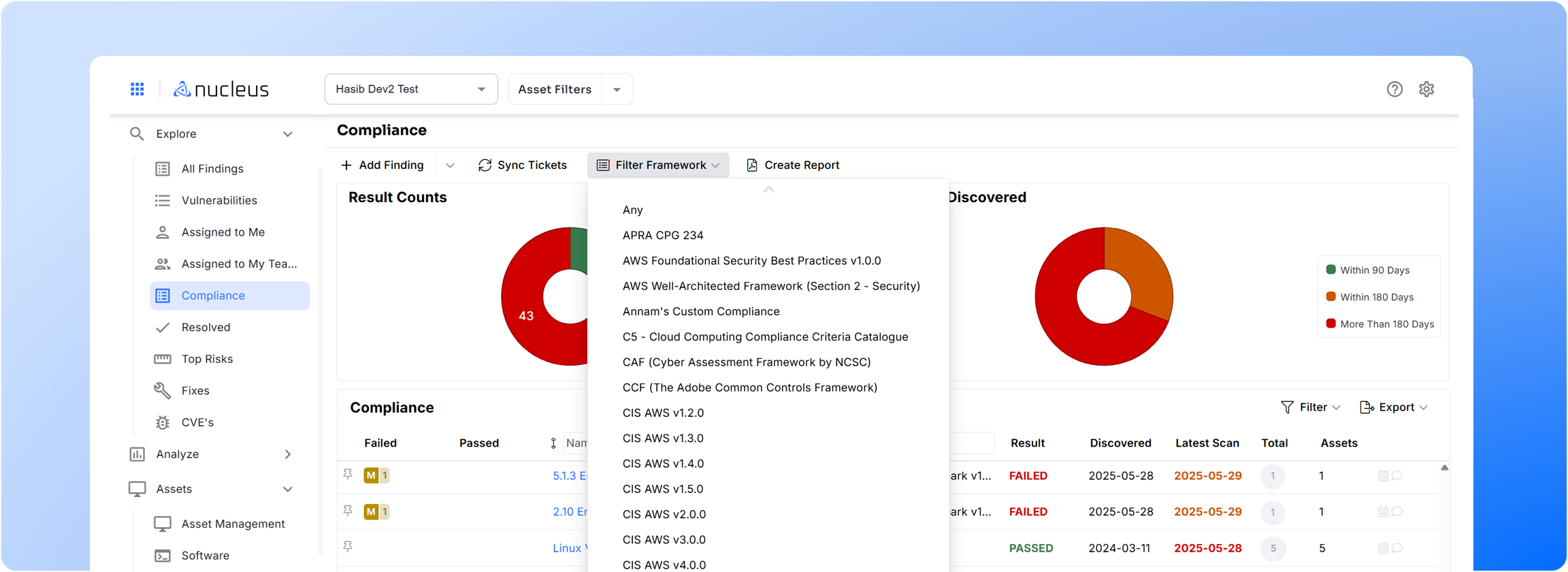
Filter Exposures by Compliance Framework
Align your vulnerability and exposure management program with compliance framework controls and requirements such as FedRAMP, NIST, HIPAA, GDPR, PCI DSS. The platform automates compliance tasks related to asset management, vulnerability tracking, and exposure remediation assignment, providing real-time pass/fail or warning statuses, affected assets, and severity levels.
Align with Industry Compliance Standards
Built for compliance, Nucleus integrates major regulatory frameworks and extends support to hundreds of sub-controls for vulnerability and exposure management. Nucleus embeds compliance rules directly into the platform, aligning exposure management with regulatory requirements while reducing manual efforts.
NIST
Nucleus maps vulnerabilities to National Institute of Standards and Technology (NIST) controls, including NIST 800-53, NIST 800-171 and 172, and NIST 800-190. Designed to help comply with controls specific to exposure risk monitoring, vulnerability scanning, exposure threat reduction, and patch management.
FedRAMP
Federal Risk and Authorization Management Program certification is an essential requirement for companies selling to the US Federal Government. Nucleus automates creation and reporting of Plan of Action and Milestones (POA&M), ensuring companies seeking or holding FedRAMP can accelerate compliance.
Cybersecurity Maturity Model Certification (CMMC)
Nucleus automates meeting the core security controls required by the U.S. Federal Government’s updated Cybersecurity Maturity Model Certification 2.0.
PCI DSS
Nucleus helps security teams meet Payment Card Industry Data Security Standard requirements by tracking vulnerabilities against various versions of PCI DSS standards such as PCI DSS 3.1, 3.2, and 3.4.

ISO 270XX and 27701
Nucleus makes it easier to stay aligned by tying vulnerability management to broader risk management processes. The platform supports multiple International Organization for Standardization (ISO) security standards, extending beyond ISO 27001 to include frameworks like ISO 27002, ISO 27017/18, and ISO 27701.
SOC 2
Nucleus keeps organizations compliant with the SOC 2 requirements defined by the American Institute of Certified Public Accountants (AICPA), continuously managing vulnerabilities and exposures through continuous monitoring, risk-based remediation, and strict access controls.
Australian Essential 8
Nucleus helps organizations meet Australian Essential 8 maturity levels by automating ownership assignment, vulnerability tracking, and risk prioritization to proactively minimize exposure to cyber threats.
AUDIT READINESS
Audits and Reporting
Nucleus supports audit readiness through built-in tailored compliance reports and historical vulnerability remediation records. Auditors can even be granted direct read-only access with the Nucleus platform’s built-in auditor user role.
Regulatory Compliance FAQs
How can I manage POA&M workflows for vulnerabilities?
You can manage POA&M workflows by centralizing Plan of Action and Milestones directly within your vulnerability management platform. Nucleus’s automation links POA&M entries to real-time vulnerability data, assigns tasks, tracks progress, and stores evidence in a unified dashboard. The system automatically creates or updates POA&Ms when remediation deadlines are missed, embeds milestones and corrective actions into workflow steps, and gives your team visibility across all outstanding planning items so nothing slips through the cracks. This reduces manual effort and keeps your remediation timelines aligned with compliance expectations.
How do I track remediation for FedRAMP and NIST requirements?
Tracking remediation for FedRAMP and NIST starts with mapping vulnerabilities to the specific controls those frameworks require. Nucleus automatically ties vulnerability findings to relevant NIST controls (like 800-53, 800-171, and others) and FedRAMP requirements, showing real-time pass/fail or warning status for compliance tasks. As teams work fixes, the platform updates control statuses, milestone progress, and evidence in one place. Built-in compliance filters make it easy to see what remains open for both frameworks and ensure remediation aligns with control objectives and audit readiness.
How can I automate vulnerability reporting for auditors?
Use automation to generate consistent, audit-ready reports without pulling data from multiple tools. Within Nucleus, compliance reports and remediation histories are built into the platform, reflecting the latest vulnerability and POA&M status. You can schedule or trigger reports that include linked evidence, scan results, and control mapping so auditors see a clear, defensible remediation trail. For frameworks like FedRAMP and NIST, continuous monitoring feeds into these reports, meaning you maintain up-to-date documentation with minimal manual work.
BLOGS
Discover the Latest From Nucleus

See Nucleus in Action
Discover how unified, risk-based automation can transform your vulnerability management.