














EMERGING VULNERABILITY RESPONSE
Find, Prioritize, and Remediate PHP2Shell Exposure Faster
Bring asset, vulnerability, threat, and remediation context together so teams can move from a newly disclosed CVE, like PHP2Shell, to an environment-specific response.

The PHP2Shell Challenge
When a critical vulnerability emerges, the first alert rarely answers the questions that matter most: Are we affected? Where is the exposure? What should we fix first?
PHP2Shell demonstrates how quickly an emerging vulnerability can become an operational problem. Security teams must identify affected PHP instances, determine which exposures are most likely to be exploited, assign ownership, choose the right response, and verify that risk has been reduced, all while threat conditions continue to change.
Turn a New CVE Into an Environment-specific Answer
A vulnerability disclosure is only the starting point. Teams need a repeatable way to establish exposure, understand urgency, and mobilize the right owners. In this PHP2Shell example, Nucleus connects three views into one workflow:
- Identify: Confirm the CVE is present and locate the associated findings.
- Prioritize: Combine exposure counts with exploitation evidence and threat context.
- Remediate: Translate intelligence into governed actions, ownership, and verification.
Identify PHP2Shell in the Environment
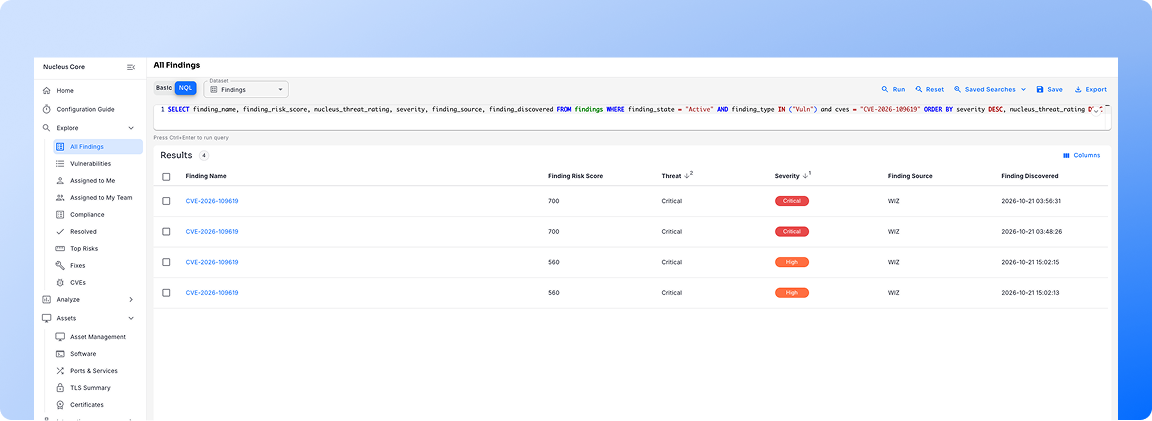
Nucleus gives teams a consolidated view of the finding records associated with CVE-2026-109618 and CVE-2026-109619. In the example below, the product displays four active findings, along with severity, Nucleus Threat Rating, risk score, source, and discovery timestamps. Instead of working from a generic advisory, the team can begin with evidence from its own environment.
What This Gives the Team
- Evidence that the CVE appears in the environment
- A clear set of finding records to investigate and assign
- Source and discovery context for coordinating the response
- A foundation for measuring exposure without overstating asset impact
Why it matters: Nucleus converts “a critical vulnerability exists” into “this is where it appears in our data.” Nucleus Discover can further help teams surface potential exposure before traditional scanner signatures are available or the next scan cycle completes.
Prioritize the Exposures That Demand Attention
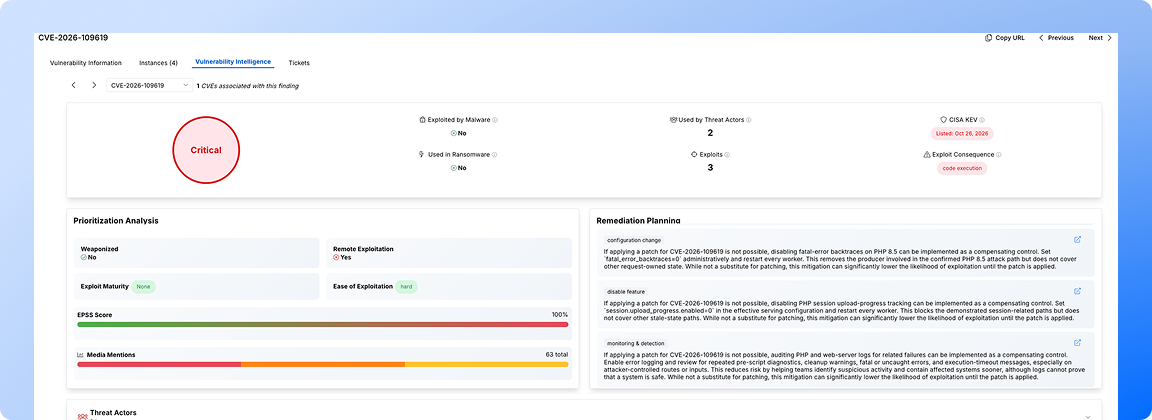
Finding a CVE does not automatically establish its urgency. Nucleus enriches the vulnerability with the signals teams need to assess the threat: Critical rating, CISA Known Exploited Vulnerabilities status, remote exploitation, code-execution consequence, 100% EPSS, known threat actors and exploits, and practical remediation planning.
Quantify the CVE-specific Impact
The exposure dashboard connects that intelligence to the affected environment. For CVE-2026-109618 and CVE-2026-109619, the product shows a count of four affected instances. That CVE-specific count is distinct from the dashboard cards that summarize eight instances across two related CVEs.
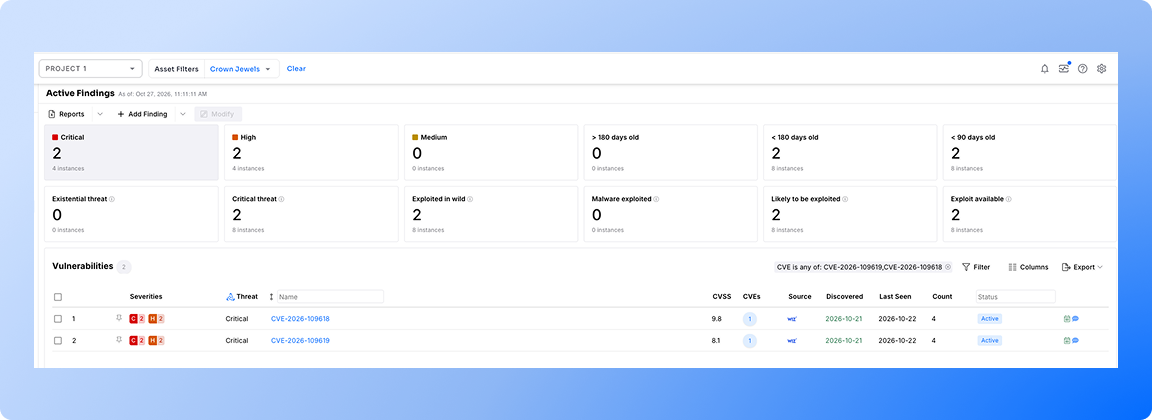
The value: Teams can focus first on the PHP2Shell exposures with the strongest combination of exploitability, consequence, threat activity, and environmental impact instead of treating every vulnerability as equally urgent.
Move from Intelligence to Governed Remediation
The response doesn’t end with prioritization. Remediation planning provides concrete options teams can evaluate when immediate patching is not possible, including configuration changes, feature-level mitigations, and monitoring guidance. Those recommendations become structured inputs for the organization’s existing ticketing and automation processes.
Trigger
Apply an approved policy threshold using signals such as Critical threat rating, CISA KEV status, remote exploitability, or EPSS.
Scope
Target the instances and owners associated with the CVE.
Respond
Apply the vendor patch when available or select an approved compensating control when patching must wait.
Route
Create and enrich a remediation ticket or pass a pre-authorized action to the appropriate automation platform.
Verify
Require evidence of success and use refreshed findings or rescanning to confirm that exposure is mitigated before closure.
Know What PHP2Shell Means to Your Environment
Emerging vulnerabilities compress the time between disclosure and exploitation. Nucleus helps teams compress the time between awareness and action. By bringing together asset visibility, CVE-specific exposure, threat intelligence, prioritization, remediation guidance, ownership, and verification, Nucleus turns PHP2Shell from another urgent alert into a coordinated response.
The Outcome
Security and IT teams can answer where PHP2Shell exposure exists, why it matters, who should act, and how to track risk reduction using one connected operational view.
Are You Vulnerable to PHP2Shell?
See how Nucleus Security helps you find and remediate PHP2Shell exposure with a platform walkthrough.
BLOGS
Discover the Latest From Nucleus

Command Your Own AI: The Missing Control Layer Between AI and Security Data
Choosing your AI is only the beginning. The bigger question is how much control that AI should have over your security data.
READ MORE
How to Tell Whether Your CTEM Program Is Working
Key metrics to monitor when evaluating how your Continuous Threat Exposure Management (CTEM) program is performing.
READ MOREWatch a Demo Today
Learn more about the Nucleus Unified Vulnerability Management platform right away.
Watch our in-depth, on-demand demo to see us in action.


