
















NIST’s NVD Shift Changes the Rules for Vulnerability Management
NIST’s recent update to the National Vulnerability Database (NVD) marks a turning point for enterprise vulnerability management teams. It’s not broken; it hit scale limits that NIST was forced to address. Now, every vulnerability management program built around it has a problem.
What NIST Announced
In response to record CVE growth, NIST’s NVD Operations made an announcement that shakes the foundation that enterprise vulnerability management programs built upon.
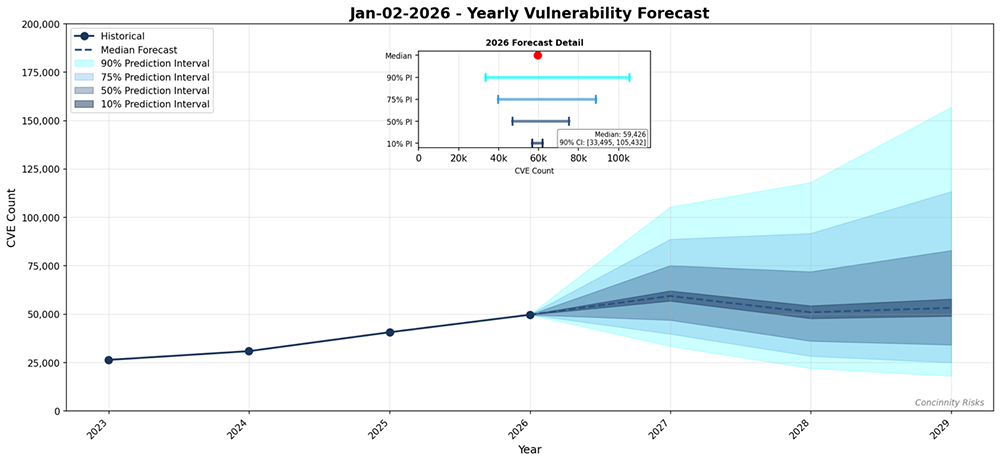
How fast are new CVEs being published? According to FIRST.org’s 2026 Vulnerability Report, 2026 will likely be the first year ever to exceed 50,000 published CVEs. This was before Claude Mythos sent shockwaves through the vulnerability management community.
Because of this growth, NVD will continue to publish CVEs, but enrichment will be selective and delayed for a growing portion due to the continued acceleration of new CVEs. Some vulnerabilities will receive full context quickly. Others will remain incomplete.
The change to NVD took place on April 15, 2026, and it prioritizes CVEs that fall under these categories for enrichment:
- CVEs that appear in CISA’s Known Exploited Vulnerabilities (KEV) Catalog
- CVEs that affect software used in the federal government
- CVEs for critical software, as defined by Executive Order 14028
NVD as the Foundation of Vulnerability Management
To understand the impact, it helps to recognize what NVD has historically done.
The CVE system provides identifiers in the form of a shared language for vulnerabilities. But CVEs alone are not enough to run a program. NVD has been the layer that turns those identifiers into something actionable:
- Assigning severity (CVSS)
- Mapping vulnerabilities to affected products (CPE)
- Categorizing weaknesses (CWE)
- Aggregating references and context
This enrichment layer became the translation engine between vulnerability disclosure and operational decision-making. While organizations didn’t explicitly design their programs around NVD, their tools, workflows, and policies did.
The Real Impact: Decision Latency, Not Visibility
NIST’s change of direction won’t show up as a visibility problem. Most teams already have more findings than they can reasonably act on. What changes is how quickly and how confidently security teams can decide what matters.
Programs that rely on NVD’s vulnerability enrichment for the information they need to make prioritization decisions will begin to flounder. The inconsistencies that inherently underly the CVE system, such as conflicting severities across different CNAs reporting on the same vulnerability or finding details from different scanners, will continue to widen as the NVD enrichment backlog grows.
If a CVE ships without enrichment, your scanners will still flag it, and your team will have to reconcile conflicting severities and missing product mappings. This will add hours, or days, to each decision the team must make. Multiply that across thousands of findings and your prior backlogs will look small by comparison.
A newly disclosed OpenSSL vulnerability might show up in scanners immediately, which will provide the essential details, including which assets are affected. Without enrichment, however, security teams will be missing crucial data points required by compliance, prioritization processes, and established playbooks. That gap will mean the difference between educated guesswork and informed prioritization.
For example, a newly disclosed OpenSSL vulnerability might show up in scanners immediately, which will provide the essential details, including which assets are affected. Without enrichment, however, security teams will be missing crucial data points required by compliance, prioritization processes, and established playbooks. That gap will mean the difference between educated guesswork and informed prioritization.
The first thing to break will be SLAs, thanks to indecision, and automation pipelines failing due to missing fields. Ticketing workflows, in turn, will stall, and the organization will stand at increased risk for a damaging breach.
Riding the Shifting Tides of Vulnerability Intelligence
From our perspective, this shift was inevitable.
We’ve been operating under the assumption for some time that vulnerability intelligence would become more fragmented, not less. Vendor advisories, government sources, CNAs, and threat intelligence feeds each contribute a piece of the picture, but none provide a complete view on their own.
That’s why we made a deliberate decision to move away from static scoring models and toward a more dynamic approach to prioritization. The path we took was built on aggregating and interpreting multiple risk signals in context.
The industry has leaned heavily on severity as a proxy for risk. CVSS made that possible. It also created a false sense of precision.
A score, on its own, doesn’t tell you what to fix first. It doesn’t account for exploitation activity, asset exposure, or business impact. What matters now is the ability to evaluate risk using whatever information is available, and to continuously update that evaluation as new context emerges.
Most programs already ingest and normalize. That’s not the problem. The gap is in how they resolve conflicting signals fast enough to act.
Nucleus Insights and Threat Rating Fill the NVD Gap
We introduced Nucleus Insights and the Nucleus Threat Rating with this exact challenge in mind, even if we didn’t know exactly what form the challenge would take. We couldn’t anticipate that NIST would limit NVD enrichment, but having broad evidence-based intelligence as early as possible is crucial in today’s world of shrinking exploitation windows.
Nucleus Insights aggregates multiple threat signals, including observed exploitation, malware or ransomware use, likely exploitation, public exploit availability, and OT impact. The Nucleus Threat Rating then converts those signals into a five-level rating system. The result is a normalized threat signal that helps teams automate prioritized action based on real-world exploit-pressure.
This matters because Nucleus doesn’t require NVD enrichment to exist before it can provide a threat-informed signal. In a post-universal-enrichment model, that helps preserve prioritization continuity when CVSS, CPE, or other NVD-derived fields are missing or delayed.
The operational value is that Nucleus separates enrichment from prioritization. Nucleus Insights supplies the threat context; the Nucleus Threat Rating packages that context into a decision-ready rating; and customers can combine it with asset exposure, business criticality, ownership, and SLAs inside their remediation workflows.
Because these signals are available inside the Nucleus platform, they can be used directly in vulnerability analysis, automation workflows, and reporting. That means teams can create rules that route, escalate, monitor, or report on vulnerabilities based on exploitation evidence and Nucleus Threat Rating rather than waiting for NVD metadata to complete.
The End of Passive Enrichment
For a long time, vulnerability management has been reactive to enrichment. Data arrived, was scored, and then you acted on it.
That model assumes someone else is responsible for completing the picture. NIST’s update makes it clear that responsibility is shifting.
High-performing teams won’t wait for perfect data. They combine signals, apply context, and make decisions under uncertainty. They treat enrichment as a continuous, distributed process and not as a one-time event tied to a single source.
Forcing a Vulnerability Management Reset
NIST’s announcement will change how organizations think about vulnerability prioritization.
The change won’t come immediately, and it likely won’t be uniform either. But over time, the programs and teams that adapt will move away from dependence on centralized enrichment and toward models that are driven by aggregated intelligence and contextual risk.
What will take the place of traditional vulnerability prioritization will be more of an emphasis on vendor-driven enrichment, not as a replacement for public data, but as a way to close the gaps it can’t fill at scale.
That shift is already underway. The teams that recognize it early will have an advantage that will come not because they have more data, but because they can make better decisions with the data they have.
Vulnerability management requires you to understand risk in an environment where the data is incomplete, the signals are distributed, and the clock doesn’t stop. The advantage goes to teams that can continuously reinterpret vulnerability risk as new signals arrive. Nucleus Insights and the Nucleus Threat Rating give teams that operating layer: a threat-informed, continuously updated way to prioritize CVEs even when the public enrichment pipeline is incomplete.
If your program depends on NVD to finish the data before you act, your process will inevitably slow to a crawl. That’s the real risk here. It’s not missing vulnerabilities; it’s failing to decide on them fast enough.

See Nucleus in Action
Discover how unified, risk-based automation can transform your vulnerability management.