














Exploitability as the Countdown Clock: Prioritizing Vulnerabilities Before Time Runs Out

In vulnerability management, every scan tells a story. The truth is that only some of those stories matter right now and that the challenge isn’t finding vulnerabilities. It’s knowing which ones are about to cost you.
If you're dealing with hundreds of vulnerabilities per asset, especially if you’ve adopted cloud solutions, you're not alone. That's become the norm. But you can’t patch everything, and you shouldn’t even try. The real risk lies in what’s actively exploitable. And when a proof of concept (PoC) drops, the countdown begins.
As Tony Ramirez, Manager of Channel Enablement and Training at Nucleus, said in a recent webinar with Thrive, “When we start looking at vulnerabilities, that proof of concept is kind of the hourglass. That’s really the thing where when you see that, the hourglass flips and the time starts to count down.”
From Noise to Urgency: Why Exploitability Matters
The Common Vulnerability Scoring System (CVSS) was designed to bring consistency to vulnerability severity scoring. But severity isn’t the same as exploitability. CVSS tells you what’s possible. Exploitability tells you what’s probable. One is more theory while the other is more threat.
This is where the industry has gone wrong. Too many teams fixate on CVSS 9s and 10s while missing the threats actively being weaponized. And when considering vulnerability findings, that CVSS score alone doesn’t tell the whole story. “Only a small sliver of that is actually a true positive,” said Ramirez. “Not all the criticals actually need to be remediated. And in fact, some of the stuff that isn’t even marked as critical is exploitable.”
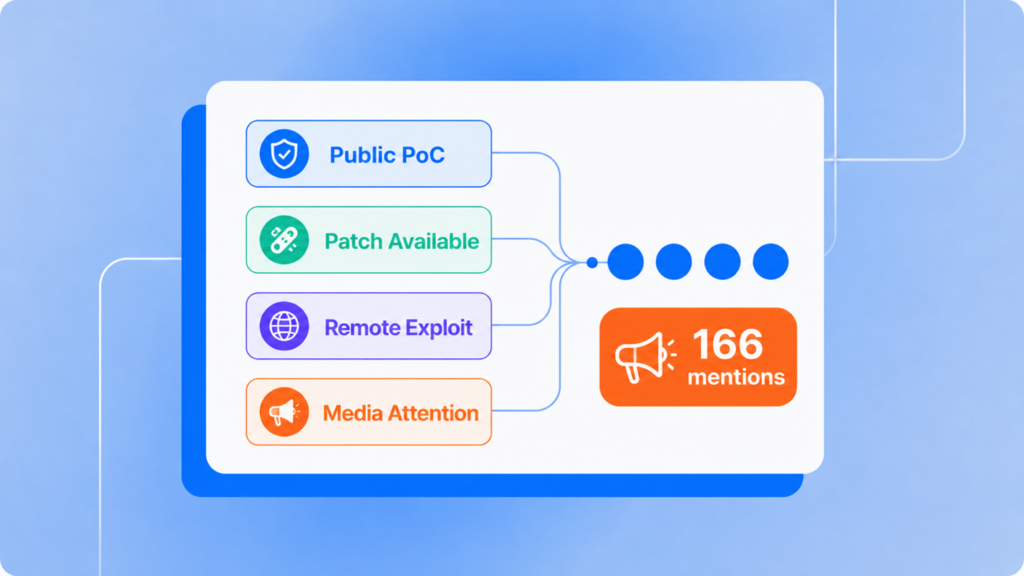
Proof of concept code, threat intelligence feeds, and real-world exploitation signals are what transform theoretical risk into actual business exposure. And once that happens, you're no longer on your timeline.
You're on the attacker's timeline instead.
The Proof of Concept Is the Pivot Point
A proof of concept isn’t just a code snippet. It’s a signal. It means someone has figured out how to weaponize a vulnerability. And from that moment on, it’s only a matter of time before it gets used in the wild.
PoCs often surface before signatures are available. They sometimes appear before vendors are able to patch their products. This is why PoC activity is one of the strongest predictors of exploitability and why it should immediately elevate a vulnerability’s priority.
Once the hourglass flips, you have two options. You can act fast ... or you can let the headlines write your incident report for you.
Static Scores Don't Match Dynamic Threats
Traditional severity scoring, like CVSS, is useful for triage. However, it’s insufficient for real-world prioritization. CVSS assumes a hypothetical worst-case scenario. It doesn’t account for:
- Availability of PoCs
- Active exploitation
- Asset criticality
- Mitigations already in place
Meanwhile, attackers don’t care about your thresholds. They’re using low- and medium-severity CVEs all the time. According to Ramirez, “Those medium and lows are the ones that are really truly scary, especially when they become exploitable.”
EPSS: The Probability Forecast That Fills the Gap
The Exploit Prediction Scoring System (EPSS), maintained by FIRST.org, is designed to address this gap. It uses real-world data to predict the likelihood of exploitation in the next 30 days. A vulnerability with a moderate CVSS score but a high EPSS is likely more dangerous than many of the CVSS 10s in your backlog.
And when paired with business context—how critical an asset is, what it connects to, and who relies on it—you have a framework for data-driven, impact-aware prioritization.
How CTEM and Nucleus Help You Act Before Time Runs Out
The Continuous Threat Exposure Management (CTEM) model offers a modern, proactive alternative to legacy VM programs. It centers exposure, risk, and validation—not volume. It also demands coordination across security, IT, and the business. “We can’t go out and address all of these exposures in a vacuum,” said Kevin Landt, VP of Product, Cybersecurity at Thrive. “It needs to be part of the larger business.”
Nucleus helps customers execute on CTEM principles by:
- Aggregating and normalizing vulnerabilities across tools
- Enriching with threat intelligence, PoC tracking, and exploitability scores
- Contextualizing findings by asset value, criticality, and mitigation state
- Automating prioritization so that the riskiest issues rise to the top, before attackers get there first
Time Is the Real Vulnerability
Most security teams don’t lack data. They lack decisions informed by multiple layers of intelligence and context. Every vulnerability creates a window of opportunity, but only some of those windows are open wide enough for attackers to climb through.
The moment a PoC is published, your window starts to close. Exploitability isn't just another field in your scanner. It's your countdown clock.
Know when it starts ticking. Know how much time you have. And most importantly, know what you need to fix first. Using Nucleus, you can monitor proof of concept activity across dozens of sources and automatically elevate findings based on real-world exploit signals. It’s not just about volume. It’s about surfacing what matters, fast.

See Nucleus in Action
Discover how unified, risk-based automation can transform your vulnerability management.