












Custom Risk Scoring Is the Missing Link Between Disconnected Findings and Real Exposure Management
Most large organizations rely on multiple vulnerability and exposure scanning tools out of necessity. Infrastructure scanners, cloud security platforms, application security testing tools, container scanners, and attack surface management solutions all play a role. Each one is designed to answer a specific question. But when it comes to understanding the risk of the vulnerabilities and exposures they detect, each tool has its own approach to quantifying it. And each one insists its scoring model is the right one.
The problem only gets more complex from here.
When teams try to build an automated vulnerability remediation process, the volume of data is only one part of the problem. The other is the inconsistency of severity information across sources and among vulnerabilities and exposures of different types. A vulnerability marked critical in one scanner may be medium in another. Two tools may detect the same underlying issue but assign entirely different severities based on opaque logic.
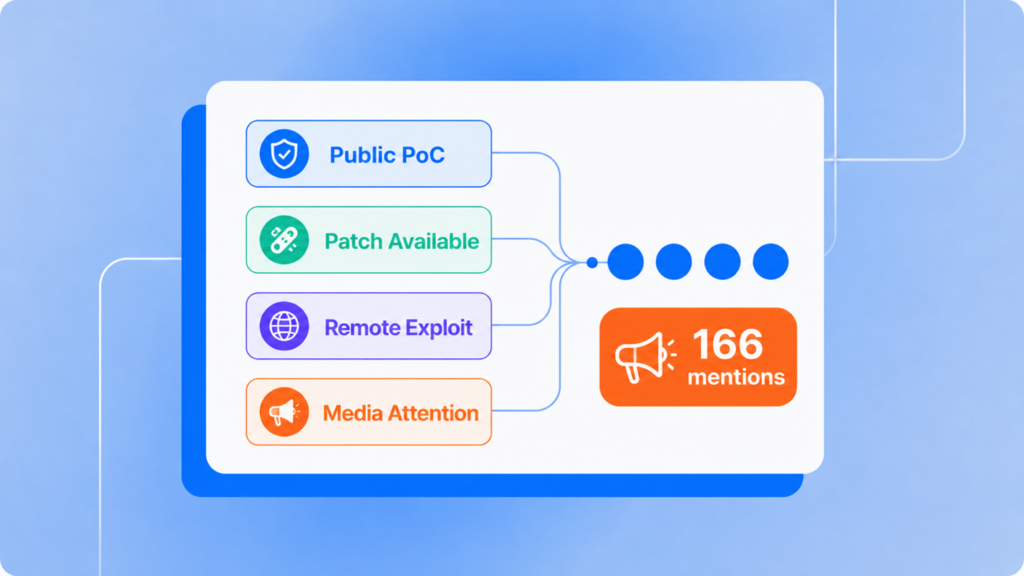
Very often, upstream scanner sources provide inadequate context about what really matters with regard to risk. For example, they fail to answer if exploitability or exploit availability factor into the associated risk level. If your source tool doesn’t know or care about that, then you won’t have what you need to make effective decisions.
Furthermore, depending on the environment, vulnerabilities and exposures on different types of assets may require context-dependent reasons for deviating from normalized scoring used by a source tool. One type of vulnerability might be inherently less risky in my environment, for example, than under generic circumstances. Without taking that into account, my teams may spend more time and resources than necessary remediating that vulnerability than I should.
Security teams are left trying to reconcile conflicting signals while stakeholders ask a reasonable question: which of these actually matters? These factors create a disconnect that slows remediation, erodes trust in the data, and makes it harder to explain risk in a way the business understands.
One solution to this challenge is giving organizations the capability to see how risk scores are calculated and, more importantly, letting them customize those scores to better match their own security and business needs. Custom risk scoring gives organizations a sense of ownership and more control over risk prioritization decisions.
Why Off-the-shelf Risk Scores Fall Apart
Most vulnerability scanners rely on narrow scoring systems or CVSS scores lacking business context. Scoring weights are essentially fixed and likely have little to do with how your organization operates.
These scores are designed to work “well enough” across thousands of organizations. That means they are intentionally generic. They can't account for how your business generates revenue, which assets are truly mission critical, or how exposure changes based on where and how a system is deployed.
Even worse, these scores don't travel well. When teams attempt to prioritize vulnerabilities across multiple scanners, they are forced to compare numbers that were never meant to be compared. A ‘critical’ from Tool A is not the same as a critical from Tool B.
Normalizing those scores after the fact often turns into a manual exercise, involving spreadsheets and subjective judgment calls. The end result is a fragile process that depends heavily on individual expertise. When those people leave or priorities shift, that process breaks down and leaves the organization at even greater risk than before.
Context Is What Turns Findings into Decisions
An effective exposure management program depends on context. Not generic context, but context that reflects your actual risk profile.
Vulnerabilities and exposures don’t exist in isolation. The risk they pose changes based on where they live, who depends on that resource, and how likely it is to be exploited in your environment.
When scoring systems can’t incorporate that context, teams are left chasing severity instead of managing exposure. This is why many organizations feel busy but ineffective. They spend their time fixing issues with high severity scores rather than those issues that put the business at risk the most.
What organizations really need is the ability to define risk using their own terms and apply that definition consistently across all sources of vulnerability data. Instead of asking which tool to trust, teams can then focus on building a scoring model that reflects how risk actually manifests in their environment. Additionally, organizations need tools that are capable of incorporating unified scoring systems directly into remediation workflows. It does nobody good if the organization has a fantastic risk scoring model and no way to do anything with it.
Risk Scoring Is also a Stakeholder Problem
Security leaders are tasked with managing both vulnerabilities and expectations. These two facets of their responsibilities aren’t always perfectly aligned.
Engineering teams want clear, defensible priorities. Executives want to understand risk without getting lost in technical detail. Audit and compliance teams want consistency. All of this becomes harder when the risk score comes from an external system that no one fully understands or agrees with.
It is difficult to build alignment around a score you can't explain. It is even harder when that score changes depending on which tool you are looking at.
Custom risk scoring helps address this challenge by making the logic visible and adaptable. When stakeholders can see how risk is calculated and why certain factors matter more than others, conversations shift. Instead of debating whether a vulnerability is really critical, teams can discuss whether the underlying assumptions still make sense.
Custom risk scoring also allows different stakeholders to view risk according to their own areas of responsibility. Business units may prioritize differently than IT teams and executive leadership. There are legitimate instances where one of these teams may need to adjust the overall scoring methodology to account for these different points of view. An open and adjustable scoring system creates transparency and encourages accountability.
That transparency builds trust. It also makes it easier to adjust the model as the business evolves, rather than forcing teams to work around a rigid external definition of risk.
The Best Way to Merge Vulnerability Data from Multiple Tools
If every tool brings its own severity model, merging data without redefining risk simply compounds confusion and goes beyond basic technical integration problems. True consolidation requires a common language for risk that sits above individual scanners.
Custom risk scoring provides that layer. It allows organizations to ingest findings from multiple tools, normalize them against a shared risk framework, and prioritize remediation based on consistent criteria. The result is a single, defensible view of exposure that reflects both technical reality and business impact.
This approach has the added benefit of not replacing your existing scanners. It makes them more useful by translating their output into decisions your organization can act on.
Bringing it Together with Nucleus 3.0
All these reasons are exactly why we introduced Custom Risk Scoring as part of the Nucleus 3.0 release in December.
The goal was not to create another scoring system. It was to make it easier than ever before for teams to define their own and translate their system into an automated vulnerability and exposure management process. We want our customers to build, adjust, and operationalize custom risk models, allowing them to cut through inconsistent severity, align stakeholders, and focus remediation activities on what matters: reducing exposure and risk.
Tying custom risk scores to remediation policies and SLAs is nearly impossible across multiple scanners and security tools. Even if those tools offer customization of risk calculations, the overall risk score isn’t centralized or functionally actionable. Only a solution like Nucleus has access to the breadth and depth of data necessary to do that translation.
For enterprises struggling to prioritize vulnerabilities across multiple scanners, this capability represents a practical step forward. It acknowledges that risk is contextual, that no single score fits every organization, and that flexibility is not a nice-to-have at scale.
If this challenge sounds familiar, I encourage you to watch the short video below, which walks through how Custom Risk Scoring works in Nucleus 3.0 and how teams are using it to regain control over vulnerability prioritization.

See Nucleus in Action
Discover how unified, risk-based automation can transform your vulnerability management.