












Built for What’s Next: How Nucleus Became the Exposure Assessment Platform for a New Era

For nearly a decade, we’ve been building Nucleus with a clear mission: to help security teams make faster, smarter, and more business-aligned decisions about what to fix first. When we started, the world called it vulnerability management. Today, the industry calls it exposure assessment. To us, that evolution isn’t just semantics, t’s the culmination of years spent redefining how organizations understand and reduce risk.
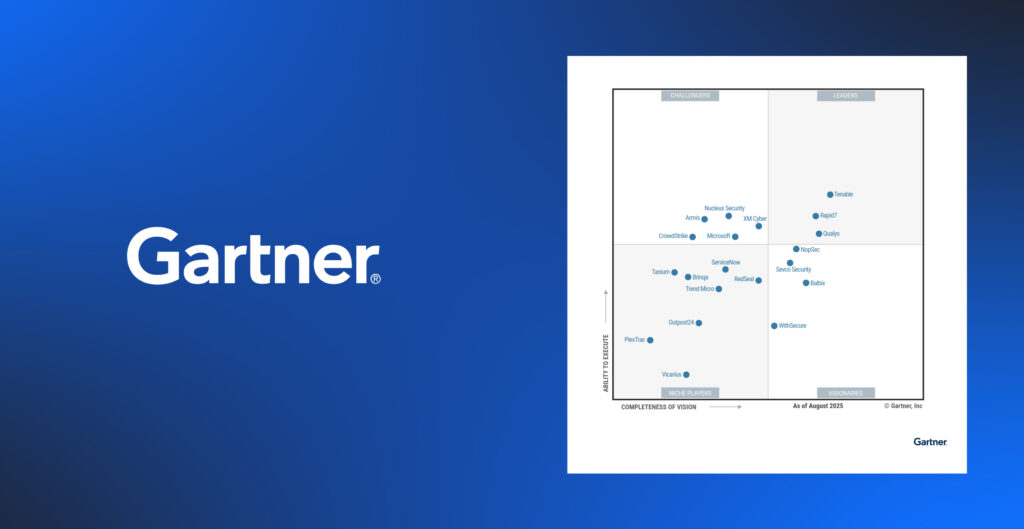
So, when Gartner® introduced its inaugural Magic Quadrant for Exposure Assessment Platforms™ and recognized Nucleus as a Challenger, it felt less like a finish line and more like confirmation that our direction has always been the right one.
From Vulnerabilities to Exposures: Why the Terminology Matters
For years, “vulnerability management” implied a linear, repetitive process. “Scan, find, fix, and repeat.” But that model no longer fits today’s environments. Modern enterprises aren’t static; they’re dynamic ecosystems of cloud workloads, APIs, ephemeral assets, and distributed teams. The idea that you can meaningfully “scan everything” once a month or once a week is outdated.
The word “exposure” better reflects reality. It’s not just about finding weaknesses; it’s about understanding how those weaknesses interact with business context, threat intelligence, and operational processes. Exposure assessment recognizes that security isn’t a list of vulnerabilities to be patched. It’s a living, adaptive process for minimizing the real-world risk your organization faces.
That’s the mindset we’ve built Nucleus around since day one. Long before exposure assessment was a category, back when we were writing the first lines of code that would become the platform you see today, we were focused on connecting the dots between discovery and remediation, between security and business.
Continuous, Contextual, and Connected
Exposure assessment demands continuity. It requires the ability to see risk as it evolves and not only as it existed during the last scan. But “continuous” isn’t just a marketing term; it’s a technical and operational challenge. When my co-founders and I first wrote the early Nucleus code, we did it in response to continuous monitoring requirements outlined in frameworks like NIST 800-53. We knew real-time visibility would one day be essential. It just wasn’t realistic then.
Today, the technology and processes finally allow us to achieve what we envisioned. We can continuously ingest, normalize, and contextualize massive volumes of data without overwhelming the teams responsible for action. That’s the foundation of exposure assessment: making sense of complex, cross-environment data so organizations can act faster and smarter.
What Sets Nucleus Apart
Many companies in our space began by solving adjacent problems: asset discovery, scanning, or patch orchestration, and have since pivoted toward exposure assessment. Nucleus was built for it from the beginning.
We didn’t think in terms of CVEs or scanner outputs; we thought in terms of risk objects, the relationships between vulnerabilities, assets, and the business systems they impact. That design choice has guided everything since. It’s why we can correlate and deduplicate data at massive scale, why we can adapt to new scanning technologies without rearchitecting, and why we can integrate remediation directly into business workflows.
But what truly differentiates Nucleus isn’t just architecture. It’s the philosophy we all follow. We’ve never measured success by feature checklists. We measure it by outcomes. Our customers’ satisfaction and operational success tell us more about our impact than any analyst report ever could.
Still, being recognized for “completeness of vision and ability to execute” in Gartner’s Magic Quadrant for Exposure Assessment Platforms means a lot. It validates that the problems we set out to solve are the same ones shaping the future of this market.
What Comes Next: Building the Next Generation of Nucleus
If exposure assessment is the “what,” then Nucleus is focused on the “how.” Our next generation of platform innovation centers on making exposure management not just continuous but optimized.
Traditional prioritization models like CVSS, EPSS, KEV lists each added incremental value but still rely on static scoring. The future lies in optimization: comparing the relative impact of different actions across your entire tech stack to find the most efficient path to risk reduction. That’s where we’re headed. We’re moving toward a platform that doesn’t just inform decisions; it will model outcomes.
AI will play a role, of course, but only when grounded in complete, high-quality data. Without that foundation, AI simply amplifies noise. That’s why our investments continue to center on data health, context, and correlation first. When we apply advanced analytics or AI, we’ll be certain that the insights are meaningful and worth the investment.
The Broader Impact
For security leaders, this shift toward exposure assessment offers more than a new technology category. It provides organizational leverage and helps CISOs make stronger budget cases, aligns remediation with business outcomes, and enables a proactive security posture grounded in measurable value.
We’ve seen firsthand how teams move from reactive patching cycles to strategic exposure reduction programs. It’s not easy. Data is complex, ownership is fragmented, and legacy processes still slow progress. Every step forward creates compounding value. The payoff is real visibility, faster remediation, and resilience at scale.
A Milestone, Not a Destination
Recognition in Gartner’s Magic Quadrant for Exposure Assessment Platforms is a significant milestone. It’s a signal that the market is catching up to what we’ve believed all along: that exposure assessment is the future of vulnerability management, and Nucleus is helping define it.
Our mission hasn’t changed. We’re still building for the practitioners who need clarity in the chaos of data, and for the leaders who need confidence that their risk reduction strategies work.
The difference now is that the world is starting to call it what it is, and we’re ready for what’s next.

See Nucleus in Action
Discover how unified, risk-based automation can transform your vulnerability management.